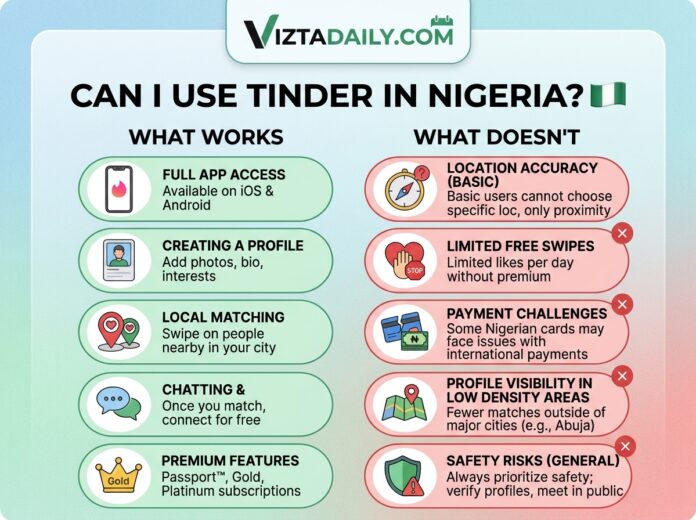
Yes, you can use Tinder in Nigeria. I found no source saying the app is blocked or banned, and Tinder even runs a city page for Lagos aimed at locals and visitors. You must be 18 or older. The free version works, but unlimited swipes need a paid plan. The main problems are noisy matches, paying in naira and scam profiles.
Last checked: prices and features change often, so treat every figure here as approximate and confirm in the app.
Is Tinder available in Nigeria?
Tinder has no official page that lists Nigeria as supported, so the evidence is indirect. The Lagos page and several Nigeria-specific payment pages show the app is live and used. Download it from your phone’s app store, sign up with your phone number or another login option, and set up a profile.
The free version. You can create a profile, swipe and chat with matches without paying. Unlimited swipes need a paid plan, so expect to run out of likes if you are very active.
Big cities. Tinder’s Lagos page shows the city is covered. Expect the most activity where people are densest, such as Lagos and Abuja, though I found no hard numbers for user counts by city.
Passport. Gold includes Passport, which lets you set your location elsewhere. It is useful if you are relocating, but be honest in your bio about where you really are.
A simple setup. Use clear, recent photos, write two lines about what you want, and set your distance range. Use the report and block tools when someone acts badly.
The second tracker also says 7.5% VAT is included in Nigerian prices.
Gold has included unlimited likes, seeing who likes you, Passport, one free Boost a month and five Super Likes a week, according to an older Codashop page. Check the current list before you pay.
Paying in naira
Your options:
App store billing: Simple, but a naira card may be declined for international spending.
Vouchers:Codashop Nigeria sells Tinder Plus and Gold and accepts Paga, cards, bank transfer and Opay.
Buy only from a seller you trust, and match the card’s region to your account.
Paying for dating apps is only part of staying safe and finding the right match. Browse our dating section for practical advice you can use before your next swipe.
What doesn’t work
Match quality. A Nigerian competitor’s ranking calls Tinder the largest pool of Nigerian users among international apps but “very noisy”, citing hookup-seekers, scam profiles from abroad and a premium paywall. That is one rival’s opinion, not neutral data, but it matches what many users report. If you want something serious, say so in your bio and filter hard in chat.
The paywall. Free users hit swipe limits quickly. Paying does not guarantee better people, only more reach.
Scam profiles. Whether the whole premise of the profile is real is the first question to ask.
Spotting scams on Tinder in Nigeria
Romance fraud is real, but it mostly points outward. In a study of 50 people convicted of romance fraud in Nigeria after EFCC prosecutions, 56% of victims were in the US. That article also cites FBI figures of more than US$1 billion lost by about 24,000 Americans in 2022.
LGBTQ+ users face legal risk in Nigeria. I could not verify the details of the law for this guide, so read the text of the Same-Sex Marriage (Prohibition) Act and take advice before using any dating app.
Tinder vs other apps in Nigeria
Tinder has the biggest international pool but the most noise. Bumble, Badoo, Twingle and eHarmony are common alternatives, compared in this Zikoko piece. If you do not want to pay, see our list of dating apps in Nigeria without payment.
Bottom line
Tinder works in Nigeria. Start free, check the in-app price before paying, be slow to trust and never send money. Real relationships do happen, but you have to filter for them.
Want more honest dating advice and news? See subscribe at Viztadaily plans.
Frequently asked questions
Is Tinder banned in Nigeria?
I found no source saying Tinder is banned or blocked in Nigeria. Tinder even runs a Lagos city page for locals and visitors. You still need to be 18 or older.
Is Tinder free in Nigeria?
The basic version is free, so you can set up a profile, swipe and chat. Unlimited swipes need a paid plan. Naira prices vary by tracker, so check the price in the app.
How do I pay for Tinder in Nigeria without a dollar card?
Use a voucher or gift card from a trusted seller, such as Codashop Nigeria, which accepts Paga, cards, bank transfer and Opay. Gift cards are in US dollars and tied to your account’s region. Match the region before buying.
Is Tinder safe in Nigeria?
It can be, if you stay alert. Never send money or gift cards, check photos with a reverse image search, and meet first in a public place. Report and block anyone who pressures you.
The best dating apps in Nigeria without payment are Facebook Dating, Bumble, Tinder, Badoo, Mingle2 and AfroIntroductions. Facebook Dating is the only one on this list with no paid tier at all. The rest are free to join and match on, but charge for extras. No app paid to be listed here, and we have not tested pricing ourselves, so check each app’s store page before you commit.
Quick answer: the top free picks
Fully free: Facebook Dating, plus Mingle2 (by its own claim).
Free with limits: Bumble, Tinder, Badoo, AfroIntroductions.
Nigerian-built, self-reported as free to start: Afrosmeet, MyPerson.ng, NaijaCupid.
Many pages ranking for this search are written by the apps they recommend, so we flag every app’s own claims as theirs.
The things that usually sit behind a paywall are unlimited swipes, seeing who liked you and extra visibility. If you have no dollar card, the free tier of each app is the one to judge.
Best for: casual browsing. It also appears in the Appfigures chart. Reviewers describe a generous free tier but mixed profile quality, so expect some fake or inactive accounts.
Start with Facebook Dating if you want to pay nothing. Add Bumble or Tinder for a bigger pool, and stay alert. Free tiers change, so confirm features on each store page. Last checked from published sources, 2026. More guides live in our Dating section.
Want more honest relationship guidance? See subscribe for Viztadaily.
Frequently asked questions
Which dating app is 100% free in Nigeria?
Facebook Dating has no premium tier, so every feature is free. Mingle2 also says it is 100% free, but that is its own claim. Check the store page for current details.
Can I chat on dating apps in Nigeria without paying?
Yes, on most. On Bumble’s free tier, women message first and both sides can keep chatting. Features like seeing who liked you usually cost money.
Are free dating apps in Nigeria safe?
Not automatically. The EFCC has said victims were lured through dating apps, especially Tinder, into paying on fake websites. Never send money and insist on a video call.
Where do I report a romance scam in Nigeria?
Report the profile to the app and to the EFCC. Reporting does not guarantee you will recover your money, so stop paying as soon as you suspect fraud.
The right dating apps nigeria offers depend on your goal: Tinder and Badoo suit casual browsing, OkCupid leans toward compatibility, and Date Nigerians and Friendite aim at local users. No single app wins for everyone. This article compares each on features, cost and safety, and shows how to set up a profile that gets real matches.
Top Dating Apps Nigeria: What Actually Works for Nigerian Users
Tinder
A dating app exists where you and another person both have to like each other before you can chat. It suits Nigerians in big cities such as Lagos and Abuja, where enough people use it that your swipes actually turn into matches. The strength is volume: you will see plenty of profiles and the process is quick to learn.
The limit is intent. Users range from people wanting a serious relationship to people wanting something casual, and a profile rarely tells you which. Expect to filter through a lot of conversations that go nowhere.
Badoo
A social app mixes chat, profile browsing and video features, and it leans toward quick, casual conversation. It suits you if you want to meet people and chat without much pressure, and less if you have a firm goal of marriage. Its main strength is how easy it is to start talking to someone, since you can browse and message without waiting for a perfect match. The limit is quality control. Many Nigerian users report a mix of genuine people and fake or low-effort profiles, so you need to be selective about who deserves your time.
OkCupid
A dating app matches you with people based on your answers about values, habits and what you want from a relationship. It suits you if you care more about compatibility than looks and are willing to spend time on a thorough profile. That is its edge: the questions help you spot differences in values early, which saves time. The limit in Nigeria is user base size. Outside major cities you may find fewer people to match with, so your results will depend heavily on where you live.
Date Nigerians
It also appeals to diaspora Nigerians who want to meet people from home without sorting through global profiles. Its strength is focus: you are searching a pool that already matches your background.
The limit is scale. A smaller, region-specific platform can mean fewer active users at any given time, so check how recently people have been online before investing in a long conversation. Treat it like any site in the wider group of dating websites Nigeria offers: verify before you trust.
Friendite
A social platform exists where the emphasis is on making friends first and building connections from there. It suits you if you prefer a slower start and would rather chat and get to know someone before any talk of dating. The strength is that softer approach, which can feel less intimidating than a pure swipe app. The limit is the same one that affects online dating Nigeria wide: a friendly setting does not guarantee honest people, so keep your guard up until someone has proved consistent over time.
VIZTADAILY (ours)
VIZTADAILY is not a dating app. It is a Nigerian news, relationships and entertainment site, so you cannot match or chat with anyone on it. What it offers is guidance to use alongside the apps above.
If you are working out how to approach someone, the Dating Tips For Men and Dating Tips For Women pages cover practical advice for each side. If you are thinking past the first date, Couple Goals and Marriage Goals For Couples look at what a lasting relationship needs. Its limit is clear: it informs your choices, but the meeting itself happens elsewhere.
How Dating Apps Work: What to Expect as a New User
As a new user, you can expect a simple loop: you build a profile, the app shows you people who fit your stated preferences, and a chat opens only when two people show interest in each other. That loop is the same on Tinder, Badoo, OkCupid or a Nigerian-focused platform. What differs is how much each app asks of you and how it ranks the people it puts in front of you.
Sign-up usually needs an email address or phone number, a few photos and some basic details: age, location, gender and who you want to meet. Most apps then ask for a short bio. Your profile is the only thing a stranger has to judge you by, so treat each field as part of that first impression. Many apps also offer photo or ID verification. A verified badge tells other users you are a real person, and it is worth completing.
Understanding the Matching Process
Apps rank the people you see using the information you give them: your age range, distance, interests and, on some platforms, answers to compatibility questions. Some also learn from your activity, such as whom you like and whom you skip, and adjust what they show you next. The more honest and complete your preferences, the better the filtering. That holds for online dating websites in Nigeria as much as for the global names. A match happens only when both of you express interest, so it signals mutual curiosity, not a commitment.
Moving from App to Real Conversation
After a match, the chat opens and the first message matters. Skip “hi” and refer to something in their profile. Keep the early conversation on the app until you feel comfortable, and be wary of anyone who pushes you to switch platforms or share personal details quickly. Our dating tips and relationship advice pages cover how to keep a conversation going and when to suggest meeting.
Creating a Compelling Dating Profile That Gets Matches
A good dating profile does three things: it sounds like you, it shows your face clearly, and it says what you want. On Nigerian apps, where many people have been burned by fake accounts, a profile that looks real and sounds honest gets more replies than one that looks polished. These steps apply whether you use Tinder, Badoo, OkCupid, Date Nigerians or Friendite.
Write a bio that sounds like you talking. Use two to four short sentences about how you spend your time, what you care about and what kind of person you want to meet. “I work in logistics in Lagos, cook a decent jollof, and I’m happiest at a football viewing centre or a quiet Sunday afternoon” tells a stranger more than “I love life and laughter.”
Name what you are looking for in plain words. Say “looking for something serious that could lead to marriage” or “open to dating and seeing where it goes.” People who are looking for the same thing will swipe right, while those who are not will move on, which saves you weeks of mismatched chats.
Pick a first photo that shows your face clearly. Use a recent, well-lit picture where you are alone, looking at the camera, with no sunglasses or heavy filters. Many users now skip faceless or over-edited photos because they have seen too many fake accounts.
Add three to five more photos that show different sides of your life. Include one full-length shot, one smiling candid, and one doing something you enjoy, such as cooking, playing football or travelling. Keep group photos to one at most, so nobody has to guess which person is you.
Match your photos to your real life. Use pictures that look like you today, not from several years ago, and avoid borrowed luxury: someone else’s car, a rented mansion, a picture from abroad if you have never been. Mismatches show up fast on a first video call or meeting, and trust rarely recovers.
Share details you are comfortable making public, and keep the rest back. Your first name, general area and job type are enough. Leave out your phone number, home address, workplace name and social media handles until you have built real trust.
Be specific about your interests instead of listing generic ones. “Afrobeats, Nollywood and suya on Fridays” gives a match something to reply to. “Music, movies and food” gives them nothing.
Fill in every section the app offers. Complete profiles, including job, education and interests where the app asks for them, give the matching system and other users more to work with, and they signal you are serious. If an app offers photo or ID verification, complete it, since a verified badge helps genuine people stand out.
Remove the lines that put people off. Skip “no drama,” “no gold diggers,” “don’t message if you’re broke” and similar warnings. They read as bitter or demanding, and they say more about past hurt than about who you are today. State what you want positively instead.
Proofread, then ask a friend to read it. Typos and copy-pasted lines from other profiles make you look careless or fake. A friend can tell you quickly if the bio sounds like you.
Update your profile now and then. Swap in fresh photos, adjust your bio if your goals change, and delete anything outdated. A profile that looks maintained suggests you are an active, genuine user.
If you want more guidance on presenting yourself well, VIZTADAILY has dating tips for men and dating tips for women that go further into first messages and early conversations. You can also browse the Dating and Couple Goals sections for more on what comes after the match.
Free vs. Paid Dating Apps: Which Features Actually Matter
Tinder
Badoo
OkCupid
Date Nigerians
Friendite
Built for
Casual to serious dating
Meeting and chatting
Values-based matching
Nigerians dating Nigerians
Friendship and dating
How you match
Swipe on profiles
Browse and chat
Questions drive matches
Local profile browsing
Social-style connections
Best fit
Wide pool, quick start
Chat-first people
Serious daters
Diaspora and home-based
Slower, friendship-first
Free versions are enough to start, and paid tiers only matter once you know what you want. Every app in the table has features available to users. What you pay for later is mostly reach and convenience, not the ability to actually meet someone.
The table points to a more useful question than “free or paid?”: what is each app built for? OkCupid’s question-led matching suits you if you want a partner whose values line up with yours, and that work happens whether or not you pay. Date Nigerians suits you if the goal is a Nigerian partner specifically, which is why it also appeals to people abroad. Tinder gives you the largest pool to sort through, which is a strength if you’re patient and a drain if you’re not. Badoo rewards people who like to talk first, and Friendite fits those who would rather let a connection grow before calling it dating.
You can get real results without spending. Fill every profile section, add clear photos of your face, and write a bio that says something specific about your life, not a list of adjectives. Message first, and open with something from the other person’s profile instead of a bare “hi”. Give each app a few weeks of steady, daily use before judging it. Free users who do this often outperform paying users who log in once a week.
Upgrading makes sense in a narrow set of cases. If you have used an app consistently, your profile is strong, and you are still being seen by too few people, paying for more visibility may be worth trying for a short period. The same goes if you’re relocating or travelling and want to meet people in a new city.
Don’t pay because a screen tells you to hurry, and don’t pay to fix a weak profile. A premium tier makes a good profile easier to find. It won’t make a vague one attractive.
If you’re still comparing the top dating websites in Nigeria, start with the one that matches your goal, run it free, and let your own results tell you whether a paid tier earns its place. VIZTADAILY’s Dating Tips For Men and Dating Tips For Women pages cover how to approach first messages and conversations once you have matches.
Safety on Nigerian Dating Apps: Avoiding Scams and Protecting Your Privacy
Most harm comes from rushing, not from the apps themselves.
Spotting Fake Profiles and Scammers
Scammers follow a script, and the script is easy to recognise once you know it. Watch for these signs:
Photos that look like a model shoot or a stock image, with no casual or group pictures.
A bio that is vague, or a profile that claims to be an oil engineer, soldier or doctor working abroad.
Fast declarations of love within days, with pet names and talk of marriage before you have spoken properly.
Refusal to join a live video call, always with a fresh excuse.
Any request for money, airtime, data, gift cards, or crypto, however small or urgent.
Run a quick check before you invest emotionally. Do a reverse image search on their photos, ask for a short video call, and see whether their story stays consistent over several days. Real people can be shy, but they can still show their face.
Protecting Your Personal Information
Share less than feels polite. Keep your full name, workplace, home address, BVN, and bank details off your profile and out of early chats. Avoid posting photos that reveal your street, gate, or office. Use the app’s own chat until you trust the person, and review each app’s privacy settings so your exact location and last-active status are hidden where possible. A single screenshot of an intimate photo can be used against you, so think twice before sending one.
Meeting Someone Safely in Person
Move off-app only after a video call and consistent conversation. For the first meeting, choose a busy public place in daylight, such as a restaurant or mall, and arrange your own transport. Tell a friend where you are going, share your live location, and agree a check-in time. Don’t accept a ride from them or go to a private home. If anything feels off, leave.
Which Dating App Matches Your Relationship Goal
The right app depends on what you want from it, so start by naming your goal. If you want something serious, pick the platform where people say they are looking for a relationship and fill in their profiles properly. Date Nigerians and Friendite are built around a Nigerian user base, which makes them a sensible first stop for marriage-minded singles. OkCupid asks detailed questions before it matches you, so it suits people who care about values and lifestyle fit.
If your aim is casual dating or simply meeting new people, Tinder and Badoo have the largest pools to browse. Be honest with yourself here. A serious seeker on a swipe-heavy app will spend more time filtering than talking.
If you live abroad, a Nigeria-focused app such as Date Nigerians is the more direct way to reconnect with home, because the people you meet are already in the culture you are trying to return to. Tinder works for you too if you are open to meeting people in your own city.
Age and background shape what you will find. Younger users tend to cluster on Tinder and Badoo, while people who want a settled relationship often prefer smaller, goal-driven communities. Browse a few profiles before you commit your time.
Once you join, watch for these signs in your first weeks:
Matches reply with real sentences, not one-word answers.
People ask about your work, family or plans, not only your photos.
Someone suggests a voice or video call before asking to meet.
Nobody pushes you to move to another app or send money.
If none of this happens, change your profile or your platform, not your standards. For more on setting clear relationship goals, see our guidance, and browse Dating Tips For Men and Dating Tips For Women on VIZTADAILY for practical next steps.
Frequently asked questions
Which dating app works best for finding serious relationships in Nigeria?
No single app wins for everyone, but apps built around Nigerian users, such as Date Nigerians and Friendite, tend to suit people who want a relationship with someone local or culturally familiar. Tinder and OkCupid reach wider pools. Your results depend more on a clear profile, honest intent and patience than on the app itself. Pick one or two and use them properly.
Are Nigerian dating apps safe and how do I avoid scams?
Dating apps are safe enough when you stay alert, but scams exist. Watch for profiles with polished photos and thin details, people who push you off the app fast, and anyone who asks for money, airtime or gift cards. Never send funds to someone you haven’t met. Do a video call before meeting, and choose a public place for a first meeting.
What’s the difference between free and paid dating apps in Nigeria?
Free versions let you create a profile, browse and often match and chat, but they usually limit extras such as how many people you can see or message. Paid plans typically add perks like extra visibility, advanced filters or more messaging freedom. Try the free version first. Upgrade only if a specific limit is blocking you from reaching genuine matches.
How do I write a dating profile that actually gets matches on Nigerian apps?
Use clear, recent photos, including one smiling face shot and one full-body picture. Write a short bio that says who you are, what you enjoy and what you want, such as a serious relationship. Be specific rather than generic. Mention your city, work or interests to give people something to reply to. Avoid copied lines, and keep the tone honest and warm.
You’ve read the listicles. “Be confident.” “Be yourself.” “Use better photos.” And yet you’re still staring at a phone full of dead conversations, wondering what you’re doing wrong.
Here’s the thing most **modern dating tips for men** won’t tell you: the problem usually isn’t your profile or your opening line. It’s the gap between who you are online and how you show up in person. It’s the missing emotional skills nobody taught you. It’s the burnout from treating dating like a second job.
This guide is different. We’re not recycling the same ten tips you’ve seen everywhere. Instead, we’re covering what actually moves the needle—from building attraction naturally to navigating the messy transition from texting to a real first date to protecting your mental health while you’re putting yourself out there. Whether you’re new to **dating apps** or you’ve deleted and re-downloaded Hinge four times this year, this is the resource you keep coming back to.
Build a Life That Attracts—Don’t Just “Work on Yourself.”
Every dating advice article tells you to “focus on self-improvement.” Hit the gym. Read more books. Get a hobby. That’s fine, but it misses the point if you’re doing it *only* to attract someone.
The guys who succeed at dating aren’t checking off a list of self-improvements. They’re creating lives they actually love, and that energy is contagious.”
Why “Having a Life” Is the Real Attraction Strategy
Attraction isn’t a transaction. You don’t earn it by collecting achievements. What draws people in is aliveness—the sense that you’re engaged with the world, curious about things, and not waiting for a relationship to make your life feel complete.
Think about the last time you met someone who was deeply passionate about something—cooking, climbing, building furniture, whatever. That enthusiasm is contagious. It makes people want to be around you. Not because of the hobby itself, but because of the energy behind it.
Actionable steps:
Audit your week. If your entire social life revolves around work and screens, that’s your starting point. Add one activity per week that puts you around new people—a running club, a language class, a volunteer shift.
Invest in friendships. Men with strong friendships are less likely to put pressure on romantic relationships to meet every emotional need. That’s attractive.
Pursue something with no dating motive. Learn to weld. Train for a half-marathon. Start a garden. The point is to have something that’s yours—something that gives you stories, skills, and a sense of identity beyond “guy looking for a girlfriend.”
Pro Tip: When someone asks "So, what do you do for fun?" on a date, your answer should light you up. If it doesn't, that's a sign you need to invest more in your own life before investing in someone else's.
The “Complete Person” Mindset
A common trap: believing a relationship will fix loneliness, boredom, or low self-worth. It won’t. Relationships amplify what’s already there. If you’re fulfilled on your own, a partner adds to that. If you’re empty, you’ll lean on them to fill the void—and that weight crushes most early connections.
This doesn’t mean you need to be perfectly happy before dating. Nobody is. But you should be able to answer this honestly: “Am I looking for someone to share my life with, or someone to give my life meaning?” The first is healthy. The second is a setup for codependency.
Master the Art of Intentional Dating (On and Off Apps)
Intentional dating means knowing what you want, communicating it clearly, and making choices that align with your actual goals—not just swiping out of boredom at 11 PM.
Dating App Tips for Guys That Actually Work
Let’s be honest: most men use dating apps poorly. They swipe on everyone, send generic openers, and wonder why they get ghosted. Here’s how to use apps with purpose.
Your profile is a filter, not a billboard. The goal isn’t to appeal to everyone. It’s to attract the right people and repel the wrong ones. That means:
Photos: Use 4–6 images that show your face clearly (at least one solo headshot), your body type honestly, and your life in action (not just selfies). Skip the fish pics unless fishing is genuinely a big part of your life.
Bio: Write something specific. “I love to travel and try new food” describes 80% of people on the planet. Instead: “Currently obsessed with making homemade pasta. My fettuccine is better than my conversation—but I’m working on both.” Specificity is memorable.
Prompts (Hinge, Bumble): Use these to show personality, not to list requirements. Answer prompts with a story or a joke, not a résumé bullet point.
Messaging that leads somewhere:
Reference something specific from their profile. “Hey” is not a conversation starter—it’s a notification.
Ask a question that’s easy and fun to answer. Not “What are you looking for?” on message one. Try: “Okay, your hiking photo—where was that? I need a new trail.”
Move to a date within 5–7 messages. Endless texting kills momentum. Suggest something low-pressure: coffee, a walk, or a quick drink.
[Table idea: “Dating App Comparison for Men in 2026” — columns for App Name, Best For, Profile Style, Typical User Intent, Pro Tip]
Meeting People Beyond the Screen
Apps get all the attention, but they’re not the only way to meet someone—and for many men, they’re not even the best way.
Real-life connections have a built-in advantage: context. When you meet someone at a climbing gym, a friend’s dinner party, or a community event, you already share something in common. There’s no profile to decode. You can read body language, hear tone of voice, and feel chemistry in real time.
How to approach someone respectfully in 2026:
Read the room. Is she wearing headphones at a coffee shop? Probably not the moment. Is she making eye contact and smiling at a social event? That’s an opening.
Lead with context, not compliments. “This band is great—have you seen them before?” works better than “You’re beautiful.” Context-based openers feel natural. Cold compliments feel transactional.
Accept the answer gracefully. If she’s not interested, say “No worries, enjoy your night” and mean it. How you handle a “no” says more about you than any pickup line ever could.
Pro Tip: The best "dating strategy" for meeting people offline is simply being a regular somewhere. Become a familiar face at a coffee shop, gym, bookstore, or co-working space. Familiarity breeds comfort, and comfort opens the door to conversation.
Develop the Emotional Skills Most Men Skip
This is the section competitors don’t write—and it’s arguably the most important one. You can have a great profile, solid confidence, and interesting hobbies, but if you lack emotional intelligence, your relationships will stall at the surface.
Emotional Intelligence Is Attraction
Emotional intelligence (EQ) in dating means three things:
Self-awareness—knowing your own emotional patterns, triggers, and attachment style.
Empathy—reading what someone else is feeling and responding appropriately.
Regulation—managing your reactions instead of being controlled by them.
Men are often socialized to suppress emotions, which creates a problem: you can’t connect deeply with someone if you can’t access your own feelings. And women consistently rank emotional availability as one of the most attractive qualities in a partner.
How to build EQ for dating:
Name your emotions. Sounds basic, but most men default to “fine” or “frustrated.” Practice identifying what you’re actually feeling—anxious, excited, disappointed, or hopeful. The vocabulary matters.
Listen to understand, not to respond. On a date, resist the urge to plan your next sentence while she’s talking. Actually absorb what she’s saying. Ask follow-up questions. Reflect back what you heard.
Learn your attachment style. Are you anxious (need constant reassurance), avoidant (pull away when things get close), or secure (comfortable with intimacy and independence)? Understanding this changes everything about how you date. Free assessments are available online—take one.
Healthy Vulnerability vs. Oversharing
There’s a difference between vulnerability and dumping your emotional baggage on a first date.
Healthy vulnerability sounds like:
“I was nervous about tonight, honestly. But I’m glad I came.”
“I went through a tough breakup last year. I’ve done a lot of reflecting since then.”
“I don’t have all the answers, but I know I want something real.”
Oversharing sounds like
Detailing your ex’s flaws for twenty minutes.
Trauma-dumping about your childhood on date two.
Using emotional disclosure as a way to fast-track intimacy.
The rule of thumb: share feelings, not full histories. Early dating is about building trust gradually. You earn deeper conversations by showing up consistently, not by revealing everything at once.
Navigate Early Dating Without Losing Your Mind
The period between “first date” and “official relationship” is where most men struggle—and where most dating advice goes silent. Here’s how to handle it.
The Texting-to-Date Transition
You matched. You’ve been texting for a few days. Things seem good. Now what?
Don’t let texting become the relationship. The longer you text without meeting, the more you build a fantasy version of each other—and the harder it is for reality to compete.
A simple framework:
Days 1–2: Light, fun conversation. Get a feel for personality and humor.
Days 3–5: Suggest a specific date. Not “we should hang out “sometime”—that’s vague and easy to ignore. Try: “There’s a great taco spot on 5th—want to grab dinner Thursday?”
After the date is set: Keep texting light. Don’t over-communicate before you’ve met. Save the good stuff for in person.
Managing the Expectations Gap
Here’s something nobody warns you about: the person you’ve been texting and the person sitting across from you might feel like two different people. That’s normal.
Text conversations strip away tone, body language, and physical chemistry. Someone who’s witty over text might be quiet in person. Someone who seemed reserved online might be magnetic face-to-face.
How to handle it:
Give the first date at least 45 minutes before making a judgment. Nerves are real.
Focus on how you feel around them, not whether they match the image in your head.
If there’s no spark, that’s okay. Not every match is meant to become a relationship. Thank them for their time and move on with respect.
How to Have the “What Are We?” Conversation
This conversation terrifies most men. It shouldn’t.
If you’ve been seeing someone for 4–8 weeks and things are going well, it’s reasonable to check in. You’re not being “too much.” You’re being clear.
A low-pressure way to bring it up:
“Hey, I’ve really been enjoying spending time with you. I just want to make sure we’re on the same page about where this is heading. What are you feeling?”
That’s it. No ultimatum. No pressure. Just honest communication. If they want the same thing, great. If they don’t, you’ve saved yourself months of ambiguity.
Pro Tip: The right person won't be scared off by directness. If asking a simple question about intentions sends someone running, they weren't ready for what you're looking for anyway.
Protect Your Energy: Dating Burnout Is Real
Nobody talks about this enough. Dating burnout — the emotional exhaustion that comes from repeated rejection, ghosting, and the endless cycle of hope and disappointment — is one of the biggest reasons men quit dating entirely.
Recognizing Burnout Before It Hits
Watch for these signs:
You’re swiping out of habit, not interest.
Every new match feels like a chore instead of an opportunity.
You’re becoming cynical about dating in general (“all women are…”).
You’re taking rejection personally, even from strangers.
You feel drained after dates, even good ones.
How to Recover (and Prevent It)
Take intentional breaks. Delete the apps for 2–4 weeks. This isn’t giving up — it’s recharging. You’ll come back with fresh energy and better judgment.
Limit your active matches. Talking to 10 people at once isn’t productive. It’s exhausting. Keep it to 2–3 active conversations at a time.
Debrief with someone you trust. Talk to a friend — ideally a female friend who can give you honest perspective — about what’s working and what isn’t. Outside eyes catch patterns you can’t see.
Separate your self-worth from your results. A bad date doesn’t mean you’re a bad catch. A week of no matches doesn’t mean you’re undesirable. Dating apps are algorithms, not mirrors.
Build Rejection Resilience as a Skill
Rejection stings. That’s human. But you can train yourself to handle it better.
Practical exercises:
The “100 Days of Rejection” approach. Intentionally put yourself in low-stakes situations where you might hear “no” — ask for a discount at a store, request a table upgrade at a restaurant, invite an acquaintance to coffee. The goal is to normalize the feeling of rejection so it loses its power.
Reframe rejection as data. She didn’t text back? That’s not a verdict on your worth. It’s information: she wasn’t the right fit. The faster you internalize this, the less each rejection will sting.
Journal after tough experiences. Write down what happened, how you felt, and what (if anything) you’d do differently. This turns painful moments into learning opportunities.
As dating coach Blaine Anderson puts it: “One woman’s opinion does not determine your value. If she doesn’t like you, another woman will.”
FAQs: Modern Dating Tips for Men
How do I build attraction naturally without playing games? Attraction grows from genuine confidence, emotional presence, and a life you’re excited about. Skip the manipulation tactics. Instead, focus on being curious about her, maintaining your own interests, and communicating honestly. Women notice when a man is comfortable in his own skin — that’s more magnetic than any technique.
What are the best dating app tips for guys in 2026? Use 4–6 honest photos, write a specific and personality-driven bio, and reference something from her profile in your first message. Move to an in-person date within a week. Limit active conversations to 2–3 at a time to avoid burnout. Hinge and Bumble tend to attract users looking for real relationships over casual hookups.
How do I know when to define the relationship? If you’ve been consistently seeing someone for 4–8 weeks and you’re both investing time and energy, it’s appropriate to have a direct conversation about where things are heading. Use a simple, non-pressuring check-in: “I’m enjoying this — are we on the same page?” Clarity is respectful, not clingy.
How do I handle rejection without losing confidence? Treat rejection as information, not a personal failure. Not every person will be compatible with you — that’s normal and expected. Build resilience by exposing yourself to low-stakes “no’s” in daily life, journaling about tough experiences, and reminding yourself that one person’s disinterest says nothing about your overall value.
Your Next Move Starts Today
Here’s what it comes down to: modern dating tips for men aren’t about tricks, hacks, or scripts. They’re about becoming someone who’s genuinely ready for connection — emotionally available, intentionally present, and resilient enough to handle the messy parts.
Build a life you’re proud of. Use dating apps with purpose, not desperation. Develop the emotional skills that most men ignore. Communicate clearly. Protect your energy. And when rejection happens — because it will — let it sharpen you instead of shrink you.
You don’t need to be perfect to find a great relationship. You need to be honest, intentional, and willing to grow.
Ready to put this into practice? Start with one thing from this guide today. Update your dating profile with specifics that actually sound like you. Text that match and suggest a real date. Sign up for that class you’ve been putting off. Take one step — the momentum will follow.
Bookmark this guide and come back to it. Dating is a skill, and skills improve with practice.
The morning routine for many couples is a frantic blur: alarm clocks, coffee brewing, packing lunches, and checking schedules. In the middle of this daily chaos, intentional connection often falls by the wayside.
Sending heart touchinggood morning messages to your wife is not merely a gesture of romance; it is a vital act of relationship maintenance. It is a signal, sent before the day’s stressors take hold, that says: You are the first thing on my mind, and you are my priority.
This guide explores the profound impact of intentional communication in long-term relationships, provides actionable advice on how to craft meaningful messages, and offers categorized inspiration to help you start—or sustain—this powerful daily ritual.
The Science of Small Gestures: Why Your Morning Text Matters
In relationship psychology, the concept of “bids for connection” is foundational. A bid is any attempt from one partner to another for attention, affirmation, affection, or any other positive connection.
A heart touching good morning message is a low-pressure, high-reward bid for connection. It doesn’t demand an immediate, lengthy response. Instead, it creates an emotional anchor for your wife to carry throughout her day.
When you consistently send thoughtful, appreciative messages, you are actively participating in what experts call “positive sentiment override.” This means that when you build up a reservoir of positive, daily interactions, it becomes easier for your partner to view your actions—and your relationship—through a lens of goodwill, even during moments of inevitable disagreement.
Rethinking Your Relationship: What Is Your Dating Goal?
Many married couples fall into the trap of viewing marriage as the destination. They stop actively courting one another, assuming that since they share a home and a life, the work of connection is done.
This is where the question, “What is your dating goal?” becomes surprisingly relevant, even years into a marriage.
If your goal is simply to co-exist, a quick text might feel superfluous. However, if your goal is continuous discovery, deep intimacy, and keeping the spark of mutual appreciation alive, then daily rituals become essential.
When you send a morning message, you are re-affirming your dating goal. You are declaring that you are still committed to winning her heart, day after day, regardless of how long you have been together. It shifts the perspective from “taking the relationship for granted” to “actively participating in the relationship.”
The Art of Crafting a Heart Touching Good Morning Messages
The effectiveness of a message lies in its sincerity, not its complexity. While generic “good morning, beautiful” texts are better than nothing, a truly heart-touching message is one that feels uniquely crafted for her.
1. Be Specific
Generic praise is nice, but specific appreciation is transformative. Instead of “You’re the best,” try acknowledging something specific she did yesterday or something you admire about her character.
2. Connect to Her Day
Acknowledging her schedule shows empathy. If she has a big meeting, a stressful project, or even a simple errand, mentioning it shows you are aware of her world and support her through it.
3. Maintain Emotional Rhythm
Your message should match the tone of your relationship. If you are playful, a funny, lighthearted message is perfect. If you prefer a more sentimental approach, go deeper with your words.
4. Keep it Manageable
You do not need to write a sonnet every morning. The goal is consistency, not length. A two-sentence message sent daily is far more impactful than a paragraph sent once a month.
Categorized Examples for Inspiration
While these examples are starting points, feel free to adapt them to match your voice and your wife’s personality.
Deep & Romantic
“Waking up and knowing you are my wife is the greatest privilege of my life. I hope your day is as wonderful as the happiness you bring into mine.”
“I was lying here thinking about how much life has changed since I met you, and I wouldn’t trade a single second. I love you more every morning.”
“Just a reminder as you start your day: You are the anchor of my world and the center of my heart. Have a beautiful day, my love.”
Appreciative & Supportive
“I know you have a huge meeting today. I have absolute confidence in you. You are brilliant and capable, and I’m so proud to be your husband.”
“Thank you for everything you did for our family yesterday. I know it’s not always easy, but please know I see it, and I appreciate you more than words can say.”
“I woke up feeling so grateful for you. Thank you for making our house a home and for being my best friend through it all.”
Playful & Fun
“Good morning to the woman who somehow manages to still be beautiful even when she’s just woken up. (I, on the other hand, look like a disaster.) Have a great day!”
“I hope your coffee is strong and your day is short. Can’t wait to be home with you later!”
“They say that love is the best part of life, but I think the best part is waking up next to you. Okay, maybe coffee is a close second. Love you!”
Short & Sweet
“Thinking of you this morning. Have a wonderful day, beautiful.”
“Just wanted to say I love you before you start your busy day.”
“Hope you woke up with a smile. I’m smiling just thinking about you.”
How to Sustain the Habit
The biggest challenge with any ritual is consistency. To make this a sustainable part of your marriage:
Set a Reminder (At First): If you are forgetful, a gentle reminder in your calendar for the first few weeks can help build the habit.
Don’t Overthink It: If you feel like you need to write something profound every single day, you will burn out. Some days, a simple “Thinking of you, have a great day” is perfectly sufficient.
Focus on Consistency Over Intensity: One moderate message every morning is superior to a massive, flowery message sent once every two weeks.
Listen to Her Feedback: If she mentions she loves a specific kind of message, lean into that. If she is overwhelmed at work and prefers shorter messages, respect that.
Common Pitfalls to Avoid
The “Copy-Paste” Trap: Avoid sending the same generic quotes found on social media every day. Your wife wants to hear from you, not from an anonymous internet author.
Neglecting the Context: If she is having a very hard time (e.g., family illness, extreme work stress), be sensitive. A text that is too cheerful might feel invalidating. Sometimes, the best message is: “I know today is hard. I’m in your corner, and I’m here for whatever you need later.”
Expectation of Response: Do not send a message expecting an immediate, detailed reply. She may be busy. The purpose is to provide value to her, not to get something back for yourself.
Frequently Asked Questions
How often should I send these messages?
Daily is ideal, as it establishes a predictable, comforting ritual. However, the most important thing is that it feels genuine. If daily feels like a chore, start with three times a week and build from there.
What if I am not good with words?
You don’t need to be a poet. The most heart touching messages are often the simplest. Telling her you love her, thanking her for something she did, or mentioning something you are looking forward to doing with her that evening is more than enough.
Is texting enough, or should I leave a note?
Texting is efficient for the morning, but leaving a handwritten note on the bathroom mirror or near the coffee maker adds an extra layer of effort and physical permanence. Mixing both is a great strategy.
Does this really make a difference in a long-term marriage?
Absolutely. Small, consistent acts of kindness build a foundation of security and appreciation. They counteract the “autopilot” mode that can take over in long-term relationships.
Should I send the same type of message every day?
Variety is helpful, but don’t feel obligated to change it up if you find a style that works for both of you. The consistency of the gesture matters more than the variety of the content.
Conclusion
The goal of sending heart touching good morning messages is to weave a thread of connection through the fabric of your daily life. It is a commitment to the idea that your marriage is worth the effort, even in the smallest of moments. By taking those sixty seconds each morning to express your love and appreciation, you are not just sending a text; you are investing in the health, longevity, and joy of your relationship.
At the end of a long day, have you ever stopped to consider what you have to be grateful for today? It sounds easy, almost cliche. However, beneath that query is a transformative force: thankfulness. Indeed, one of the most exciting new areas in social science, psychology, and neuroscience is how thankfulness enhances connection and mental health.
Being grateful does more than just make you feel good right now. It changes the way your brain processes failures, restores emotional equilibrium, fortifies relationships, and builds resilience. This post will reveal the science, anecdotes, and techniques that underlie the mental-health benefits of gratitude and demonstrate how to incorporate it into your life in a way that will truly last.
Here’s the bold answer up front: gratitude acts like a mental and relational fertilizer—helping positive well-being grow and deepening social soil for connection. As a result, it helps reduce depression, anxiety, loneliness, and cultivates joy, empathy, and belonging.
Let’s walk through what gratitude is, why it matters, and how you can make it a sustaining force in your mental and relational life.
“When I remember to be grateful, fear loses its grip.”
What Is Gratitude, Exactly?
Before we dive into benefits, we need a shared definition.
Gratitude as Emotion, Trait, and Practice
Gratitude has multiple dimensions:
A state or emotion: the immediate feeling of thankfulness when someone offers you a kindness or you notice something positive.
A trait: a personality-level tendency to notice and appreciate things in life (some people are naturally more gratitude-prone).
A practice or intervention: structured acts (journaling, expressing thanks, writing letters) to cultivate gratitude consciously.
Robert Emmons, a prominent researcher in gratitude, delineates gratitude as comprising two components: the acknowledgment of the goodness in one’s life and the recognition that the origins of this goodness are, at least in part, external to oneself.
In short: gratitude means noticing, valuing, and often responding with acknowledgment to things or people (or life itself) that enrich you.
The “Find-Remind-Bind” Theory
In relationship science, gratitude is said to play a social bonding role with three mechanisms: find, remind, bind etc.
Find: gratitude alerts you to people who contribute to your life (i.e. high-quality partners).
Remind: gratitude reinforces your memory of positive aspects of a relationship.
Bind: expressing gratitude helps deepen and stabilize your relational connection.
Thus, gratitude is not just a warm feeling—it’s relational glue.
Why Gratitude Matters for Mental Health
Let’s unpack the “improves mental health” piece. The evidence is strong and growing.
1. Reduction in Depression and Anxiety
A robust meta-analysis (64 randomized clinical trials) found that people who engaged in gratitude interventions showed fewer symptoms of depression and anxiety, elevated mood, and overall better mental health compared to control groups.
Other studies that look at gratitude journaling or making lists show that they consistently help with stress, depression, and emotional health.
The act of recalling things you are grateful for helps shift focus away from negative rumination—one of the core processes in anxiety and depression.
2. Enhanced Emotional Regulation & Resilience
Negative feelings are tempered by gratitude. You can develop “positive recall bias,” or the mental habit of seeing the positive even in the face of hardship, by focusing your attention on the positive aspects of life.
When people deliberately adopt grateful appraisal, they have been shown to experience physiological effects like a lowered heart rate, relaxed breathing, and a decrease in stress hormones. This can help to calm the nervous system during stressful situations.
3. Better Sleep, Health, and Somatic Well-being
Mental health is not isolated in your brain. It has deep connections with your body. Research shows that gratitude correlates with:
Improved sleep quality (people with gratitude thoughts before bedtime tend to fall asleep more easily)
Lower blood pressure, heart rate regulation, and cardio biomarkers
Greater physical health and longevity: a new study from the Nurses’ Health Study found that more grateful women lived longer, suggesting gratitude may influence mortality risk factors.
In sum, gratitude is a mind-body catalyst.
4. Increased Life Satisfaction & Subjective Well-Being
People who regularly practice gratitude report higher life satisfaction, positive emotion, optimism, and strength of meaning in life.
Even beyond clinical outcomes, gratitude simply feels good and helps anchor a sense of flourishing.
Gratitude and Connection: How They Interact
Mental health and connection are deeply entwined, and gratitude acts as a bridge.
1. Strengthening Friendships, Romantic Partnerships, and Social Bonds
A wealth of research shows gratitude helps initiate, maintain, and strengthen relationships.
Couples who express gratitude toward each other report greater relationship satisfaction, communication, and closeness.
Friends feel more connected when they receive expressions of thanks and acknowledgment. Gratitude fosters prosocial behavior—people are more likely to help, trust, and invest in others.
2. Reducing Loneliness & Building Social Cohesion
Feeling lonely and not being able to connect with others are both risk factors for mental health problems. Expressing gratitude can help with that by building trust, increasing social support, and making it easier for people to get involved in their communities.
One study on gratitude and loneliness showed that gratitude expression supports relationship satisfaction, forgiveness, and social closeness.
3. Reciprocity, Trust, and Prosocial Feedback Loops
Recipients are frequently inspired to reciprocate with kindness, generosity, or additional connections when someone expresses gratitude. Relational warmth is increased by this positive feedback loop.
Further, gratitude often triggers trust and forgiveness—helps relationships recover from friction.
4. Cultural & Evolutionary Roots of Gratitude in Cooperation
Gratitude likely evolved as a social signal encouraging cooperation, alliance, and group cohesion in our ancestral past. In other words, gratitude is literally wired for connection.
Thus, gratitude is relational glue that helps mental health by reinforcing social ecosystems.
Real-Life Stories & Anecdotes
Here are examples to bring these ideas into real life:
A. The Gratitude Letter That Mended a Relationship Years of unspoken grievances had caused Maria and Ahmed to drift apart. In her heartfelt letter of gratitude, Maria thanked Ahmed for his patience, acknowledged small gestures of kindness, and recalled times when they had laughed. He was taken aback, moved, and reciprocated. That one action changed their tone, sparked conversation, and brought them closer together again.
B. Journal of Three Blessings After Burnout “Raj” started a nightly routine after work stress overtook her: writing down three things for which she was thankful that day: a nutritious meal, a supportive partner, or a moment of companionship. She experienced improved mood, richer conversations at home, and less anxiety in a matter of weeks.
C. Gratitude in Community Volunteering A community center in a city started a “Gratitude Wall” where volunteers pinned notes about people they appreciated. This small act fostered visibility, deepened relationships among neighbors, and reduced social isolation. People reported feeling more connected to each other and to the community.
These are small-scale but powerful glimpses of how gratitude can ripple outward.
Mechanisms: How Exactly Gratitude Works in the Brain & Psyche
Especially in the medial prefrontal cortex, gratitude activates brain areas linked to reward, value attribution, social cognition, and decision-making.
Gratitude is linked to value-based decision-making because it increases neural sensitivity in the medial prefrontal cortex when people express gratitude in experiments (e.g., financial giving linked to feeling thankful).
Over time, consistent gratitude exercises may rewire these circuits, strengthening constructive emotional processing.
Gratitude shifts attention: it trains your brain to scan for good, not just threats or deficits. This attentional bias becomes a mental habit.
It also influences memory: recalling gratitude experiences strengthens recall of positive events.
It enables reappraisal: when facing adversity, a gratitude perspective helps reinterpret challenges (“What am I still grateful for?”) which supports emotional regulation.
Emotional Dynamics: Building Positive Emotions
Gratitude magnifies positive feelings more than it eliminates negative ones—it doesn’t pretend pain doesn’t exist, but expands your emotional palette.
As positive emotions accumulate, they create upward spirals: more gratitude → more joy → more social investment → more gratitude.
Behavioral Activation & Prosocial Action
When gratitude is felt or expressed, it often leads to behaviors—saying “thank you,” helping others, investing in relationships—that reinforce connection and purpose.
These behaviors, in turn, feed back into mental health and relational well-being.
Barriers, Misconceptions & the “Gratitude Trap”
Gratitude isn’t a cure-all. There are pitfalls and caveats to be aware of.
Toxic Gratitude or “Gratitude Trap”
“You must be grateful” can occasionally be used as a stifling tactic, making people feel guilty, ashamed, or indebted when they are unable to live up to inflated expectations of gratitude. This is referred to as the “gratitude trap.”
Furthermore, thankfulness shouldn’t mask injustice, suppress legitimate rage, or prevent people from establishing boundaries when they experience systemic disadvantages (poverty, abuse, etc.).
Plateau Effects & Habituation
Gratitude’s emotional impact may diminish if it seems monotonous or repetitive. For this reason, specificity and novelty are important. According to certain research, interventions involving gratitude lists that were conducted too infrequently had minimal impact.
Not a Replacement for Therapy
Gratitude is a helpful complement—not a substitute—for clinical care when dealing with severe depression, trauma, or mental illness.
Cultural & Individual Differences
Cultural scripts around gratitude, expression norms, and individual temperament moderate how gratitude is experienced and expressed. Some people may find gratitude awkward or forced initially.
Practical Strategies: Cultivating Gratitude Daily
Here’s how to make gratitude real, sustainable, and relational.
1. Gratitude Journaling / Three Blessings
Every day (or several times/week), write 2–3 things you’re grateful for. Aim for specificity (“My friend listened patiently today”) rather than generic statements. Meta-analysis evidence supports these practices reducing depression and anxiety.
2. Gratitude Letters & Visits
Write (or deliver) a letter to someone you appreciate. Tell them what they did and how it impacted you.
3. Express Gratitude in Relationships
Make a conscious effort to show gratitude in casual conversations by saying things like “Thank you for doing that” or “I appreciate you.” Regular expressions of gratitude strengthen the bonds between couples.
4. Mindful Gratitude Moments
Pause in daily life (walk, meal, breath) and consciously notice one thing you appreciate.
5. Use Prompts & Apps
Use prompt cards, reminders, or apps to cue gratitude reflection. A recent application design study among young adults confirmed structured prompts improve psychological well-being and social connection.
6. Gratitude Rituals & Shared Practice
Do gratitude check-ins at dinner, meditation practice, or group “gratitude circle” among friends or family.
7. Integrate Gratitude with Acts of Kindness
Actively return gratitude: service, support, generosity. This activates reciprocity and relational growth.
8. Refresh & Vary the Practice
Switch up formats (journals, photos, audio recording, gratitude walks) to keep the practice fresh and emotional.
Example 6-Week Gratitude Plan
Week
Focus
Practice
Reflection Prompt
1
Cultivate noticing
Morning journal: 3 specific gratitudes
“What small thing today surprised me in a good way?”
2
Express outwardly
Write one gratitude letter this week
“How did writing/expressing feel?”
3
Pause & savor
Daily 30-second gratitude pauses
“What sensations or feelings arise?”
4
Relational gratitude
Say “thank you” intentionally to people
“What changed in the interaction?”
5
Novel gratitude
Notice new gratitudes (people or things)
“What new thing did I overlook before?”
6
Sustain & integrate
Choose your favorite methods to sustain
“How has this affected my mood, relationships?”
By week 6, many report sustained uplift, renewed connection, and clearer emotional baseline.
How Gratitude Improves Mental Health and Connection: Summary of Pathways
To recap, gratitude improves mental health and connection by:
Shifting attention and cognitive bias toward the positive
Reducing rumination, anxiety, depressive thoughts
Regulating emotional responses and enhancing resilience
Activating reward circuits and neural plasticity
Promoting behaviors of kindness, generosity, trust
Strengthening relational bonds and social support
Anchoring life satisfaction, meaning, and belonging
These pathways are interconnected: deeper connection is made possible by gratitude, which in turn supports mental health by enhancing connection.
According to research, having gratitude improves one’s happiness, health, and general well-being. Additionally, gratitude strengthens existing relationships and aids in forming new ones. — Baylor studies
These underscore both the clinical and relational importance of gratitude.
Common FAQs
Q: How long does it take before gratitude “works”? A: Studies suggest effects may appear after several weeks (4–8 weeks) of consistent practice. Some immediate lifts in mood can appear too, but long-lasting change often requires habitual repetition.
Q: Is gratitude practice right for someone with major depression or trauma? A: Gratitude is a complementary tool—not a replacement—for therapy, medication, or professional care. In severe mental health conditions, start slowly and under supervision. Gratitude works best in addition to appropriate treatment.
Q: What if I don’t feel grateful or it’s hard to find things to be thankful for? A: Begin with small things (a warm drink, sunlight, a kind gesture). Use a prompt to push gently. Over time, gratitude muscles strengthen—even when mood is low.
Q: Can gratitude backfire or become “toxic positivity”? A: Yes, if it gaslights your negative feelings or demands gratitude when you don’t authentically feel it. Avoid gratitude traps—acknowledge hardship, allow discomfort, don’t force gratitude over denial.
Q: Does gratitude benefit everyone equally (cultures, ages, personality types)? A: Effects vary. Cultural norms, emotional expressivity, and temperament moderate how gratitude is felt and expressed. The key is adapting practices to your context.
Conclusion & Call to Action
If some of this feels familiar—that journaling, thank-you letters, pausing for one breath—it’s because gratitude is beautifully simple yet deeply powerful. It’s like sunlight for your emotional soil.
How gratitude improves mental health and connection is a gradual, giving development of perspective, connection, and inner strength rather than a quick fix. With time, it fortifies against hopelessness, fortifies relationships, and adds more warmth, empathy, and purpose to your experience.
I invite you: start today. Write one gratitude note, pause to savor something good, tell someone you appreciate them. Repeat tomorrow. You’ll notice patterns changing over the course of weeks: your world is a little brighter, your relationships are stronger, and your mood is more stable.
If you’d like, I can help you develop a 30- or 90-day gratitude challenge customizable to your life. Would you like me to map that out next?
Every relationship — whether romantic, platonic, or professional — thrives or falls apart based on one simple thing: communication. It’s not how much we talk that matters, but how well we connect. Have you ever tried explaining something to someone, only to feel like they’re hearing every word but understanding none of it? That invisible wall of misunderstanding is what unhealthy communication feels like — frustrating, isolating, and disheartening.
Healthy communication, on the other hand, builds bridges. It’s the heartbeat of trust, empathy, and emotional safety. When we learn to express ourselves honestly and listen with intention, relationships transform from fragile connections into resilient partnerships. It’s not about saying the “right” thing; it’s about creating space for understanding.
In this article, we’ll explore research-backed communication habits that strengthen relationships — habits you can apply in love, friendship, family, and even at work. Whether you’re trying to reconnect with a partner or simply want to express yourself better, these principles will help you build deeper, more meaningful connections.
Understanding Healthy Communication
What Does “Healthy Communication” Really Mean?
At its core, healthy communication means expressing yourself clearly and listening actively, without judgment or defensiveness. It’s the balance between speaking your truth and being open to another’s perspective. According to renowned psychologist Dr. John Gottman, couples who communicate effectively have a 94% chance of resolving conflict peacefully — not because they never disagree, but because they know how to talk about it without tearing each other down.
Healthy communication is grounded in emotional intelligence — the ability to recognize, understand, and manage your emotions while empathizing with others. It’s about replacing reaction with reflection, and criticism with curiosity.
Think of it like learning a new language — the language of connection. You’re not just exchanging words; you’re tuning in to emotion, tone, and unspoken meaning. Every gesture, pause, and sigh holds information about how someone truly feels.
When communication is healthy, you feel seen, heard, and respected. There’s no scorekeeping, no silent resentment — just mutual effort to understand.
Why Communication Shapes Every Relationship
Every thriving relationship rests on one simple foundation: feeling understood. Communication shapes how we interpret love, resolve tension, and share dreams. When it’s healthy, it fuels closeness; when it’s broken, it breeds loneliness.
Research from The Journal of Family Psychology shows that couples who engage in open and respectful dialogue report higher relationship satisfaction and longer-lasting partnerships. Similarly, in friendships and workplaces, good communication fosters trust and cooperation, reducing conflict and boosting emotional well-being.
Imagine two people standing on opposite sides of a river. Their words are the bridge. If the bridge is unstable — full of blame, sarcasm, or avoidance — no one feels safe crossing. But when communication is clear, compassionate, and consistent, it becomes a solid path toward understanding.
Healthy communication doesn’t mean you never argue. It means you argue better — with empathy, patience, and purpose. It’s the secret ingredient in every strong relationship, and it starts with small, intentional habits practiced every day.
Common Barriers to Healthy Communication
The Silent Killer – Assumptions and Misinterpretations
Assumptions are like fog in communication — they blur reality and distort meaning. We assume someone “should know” how we feel or what we meant, and when they don’t, resentment builds. Most misunderstandings don’t come from bad intentions but from unspoken expectations.
For example, one partner might say, “You never listen to me,” when what they really mean is, “I feel unimportant when you’re distracted.” The difference between accusation and expression is monumental. One closes doors; the other opens them.
The best way to overcome assumptions is to seek clarity. Instead of interpreting, ask: “Can you tell me what you meant by that?” or “Here’s how I understood — is that what you meant?” These small questions prevent massive emotional drift.
Healthy communicators replace assumptions with curiosity. They don’t assume they’re right — they aim to understand.
Emotional Reactivity and Defensive Listening
We’ve all been there — someone says something that stings, and before we know it, we’re reacting, not responding. Emotional reactivity is when our nervous system hijacks rational thinking. We listen not to understand but to defend ourselves.
According to emotional regulation research from the American Psychological Association, our brains perceive emotional threats similarly to physical danger. When we feel attacked, we enter “fight or flight” mode — and real listening stops.
To counter this, pause before responding. Take a breath, name what you feel, and remind yourself: “My goal is to connect, not to win.” This shift transforms conversations from battlegrounds into safe spaces for growth.
When both people manage reactivity, even disagreements become productive. You can disagree and still feel respected — that’s the hallmark of mature, healthy communication.
Digital Distractions and the Decline of Genuine Connection
In today’s hyperconnected world, our attention is the new currency. We often text while talking or scroll during conversations, unintentionally signaling that the person in front of us isn’t important. This digital drift slowly erodes connection.
Studies from Pew Research Center found that 70% of partners feel smartphones interfere with meaningful conversations. The solution isn’t abandoning technology — it’s mindful presence.
Try creating “no-phone zones” during meals or evening chats. Practice giving full attention — eyes, body, and heart — when someone speaks. Real connection happens not in replies but in presence.
The next time you talk, put the phone face down, lean in, and listen. You’ll be surprised how much deeper the conversation feels.
Core Habits of Healthy Communicators
Habit 1 – Practice Active Listening
Active listening is the cornerstone of healthy communication. It’s more than hearing words — it’s engaging with intent. When someone speaks, do you truly listen, or do you wait for your turn to respond? Most of us do the latter without realizing it.
Active listening means putting aside distractions, judgment, and the urge to “fix” things. It’s about creating space where the other person feels seen and understood. According to a study by the Harvard Business Review, people who feel genuinely listened to are 62% more likely to report feeling emotionally safe and valued in relationships.
Here’s how to practice it effectively:
Maintain eye contact. This signals presence and respect.
Paraphrase or summarize. Say, “So what I hear you saying is…” to show you’re tracking the message.
Validate emotions. Instead of minimizing feelings (“You’re overreacting”), acknowledge them (“That sounds really frustrating”).
Ask open-ended questions. Replace “Did that make you mad?” with “How did that make you feel?”
Try this: The next time someone opens up, resist the urge to respond immediately. Breathe, absorb, and reflect back what you understood. You’ll notice the conversation deepen instantly.
Active listening transforms communication because it replaces reaction with connection.
Honest expression is essential, but tone and delivery matter just as much as content. The goal isn’t to be brutally honest; it’s to be constructively transparent. You can express frustration without attacking.
A golden rule: speak from your own perspective. Use “I” statements instead of “You” accusations. For example:
“You never help around the house!” → “I feel overwhelmed when I manage everything alone.”
“You don’t care about me!” → “I miss feeling connected to you lately.”
See the difference? The first triggers defensiveness; the second invites empathy.
Psychologist Dr. Marshall Rosenberg, founder of Nonviolent Communication, emphasizes four components of honest expression: observation, feeling, need, and request. Instead of blaming, describe what you observed, share how you feel, identify what you need, and make a request.
Mini-story: When Maya and Sam argued, it always escalated into shouting. After learning to express needs clearly (“I need reassurance when we argue”), their fights turned into calm conversations. Over time, they learned that honesty, delivered gently, built intimacy instead of distance.
Honesty without blame nurtures trust. It tells your partner, “You can hear my truth without fear.”
Habit 3 – Validate and Empathize
Validation is love in action. It’s saying, “I get that you feel this way — your emotions make sense.” You don’t need to agree with someone to validate their feelings; you simply need to acknowledge them.
Empathy bridges emotional gaps. When someone shares their pain, avoid problem-solving right away. Sometimes, people don’t need answers — they need to feel understood.
Try this:
Validate first: “That sounds really tough.”
Empathize next: “I can imagine how that must hurt.”
Support last: “What would help you feel better right now?”
According to a study in The Journal of Personality and Social Psychology, relationships with high levels of empathy and validation experience stronger emotional bonds and quicker conflict recovery.
Empathy transforms communication from transactional to transformational. It moves conversations from “me vs. you” to “us vs. the problem.”
Habit 4 – Manage Conflict Mindfully
Conflict is inevitable — but combat isn’t. Healthy communication doesn’t eliminate disagreement; it changes how we approach it. The difference between couples who last and those who don’t, according to the Gottman Institute, is how they manage conflict.
Mindful conflict resolution starts with emotional regulation. When tensions rise, pause. Take a break if needed, and return when both parties are calmer. This isn’t avoidance; it’s maturity.
Framework for mindful conflict:
Pause before reacting. Give yourself a moment to breathe.
Name your feelings. Identify whether you’re angry, hurt, or afraid.
State your intention. Begin with “I want us to understand each other.”
Stay issue-focused. Don’t bring up past conflicts. Stick to the present.
End with repair. Acknowledge your role and suggest how to move forward.
Even in heated discussions, remember: the goal isn’t to win; it’s to understand and repair.
As relationship expert Dr. Sue Johnson says, “Conflict is an opportunity to understand your partner more deeply.” Each disagreement, handled mindfully, becomes a chance for growth.
Habit 5 – Build Daily Emotional Check-ins
Healthy relationships are maintained daily, not rescued occasionally. Just as you water a plant before it wilts, you nurture relationships with regular communication — especially emotional check-ins.
An emotional check-in is a few minutes each day to connect beyond logistics (“Did you pay the bill?”) and touch on feelings (“How was your heart today?”). It builds a sense of partnership and belonging.
You can try:
The “Highs & Lows” ritual: Share one good and one hard thing about your day.
“Love language” moments: Ask, “How can I make you feel appreciated today?”
“Two minutes of presence”: Just eye contact and gratitude before bed.
Research from the University of Rochester shows that couples who engage in regular emotional check-ins experience a 23% boost in relationship satisfaction and resilience during stress.
The beauty of check-ins lies in consistency. They’re small but powerful reminders that connection isn’t a luxury — it’s a daily practice.
Psychology Behind Healthy Communication
The Role of Emotional Regulation
At the root of every successful conversation lies emotional regulation — the ability to manage our feelings so they don’t hijack communication. When you’re calm, you think clearly. When you’re flooded with emotion, you can’t process information effectively.
Studies by Dr. Daniel Goleman, author of Emotional Intelligence, reveal that emotionally regulated individuals communicate with more empathy, patience, and clarity. They respond thoughtfully rather than impulsively.
Practical strategies to improve emotional regulation:
Pause and breathe. A 10-second pause before responding can prevent escalation.
Identify triggers. Know which topics or tones make you defensive.
Ground yourself. Focus on physical sensations (feet on the floor, slow breaths) to stay present.
Use soothing self-talk. Say, “I can stay calm and express myself clearly.”
Think of emotional regulation as the thermostat of your relationship — it prevents emotional “overheating.” When you stay composed, you make it safe for others to do the same.
Attachment Styles and Communication Patterns
Ever wonder why some people shut down during conflict while others cling tighter? That’s attachment theory in action. Your attachment style — shaped by early life experiences — heavily influences how you communicate.
Secure attachment: You’re comfortable with closeness and expression.
Anxious attachment: You crave reassurance and fear being unheard.
Avoidant attachment: You value independence and may withdraw during tension.
Recognizing your style helps you adapt. For example, if you’re anxious, practice self-soothing before reaching out. If you’re avoidant, challenge yourself to stay engaged during emotional conversations.
According to psychologist Dr. Sue Johnson, couples who understand their attachment patterns have a higher chance of creating emotionally secure relationships. Awareness brings compassion — both for yourself and your partner.
Ultimately, attachment styles aren’t destiny; they’re a roadmap for growth. By understanding them, you rewrite old communication patterns and create healthier, more balanced connections.
Communication Across Relationship Types
Romantic Relationships
Romantic relationships thrive on emotional intimacy — and the lifeblood of that intimacy is healthy communication. It’s easy to fall into routines where deep conversations fade, replaced by surface-level exchanges about errands, bills, or kids. But love isn’t sustained by logistics; it’s nourished by understanding and emotional presence.
Healthy couples make communication a daily practice. They don’t wait for conflict to talk; they use conversations as bridges that continually reconnect them. Relationship researchers at the Gottman Institute emphasize that strong relationships have a 5:1 ratio — five positive interactions for every negative one. That means for every disagreement, there should be five moments of kindness, affection, or appreciation.
To communicate effectively in romantic relationships:
Prioritize presence. When your partner speaks, stop what you’re doing. Presence signals respect.
Show appreciation regularly. Compliment effort, not just results.
Use gentle startups. Begin conversations calmly: “Can we talk about something that’s been on my mind?” instead of “You always…”
Repair quickly. After an argument, reconnect as soon as emotions cool down. Even a simple “I still love you” can mend walls before they harden.
Healthy communication in love means talking with your partner, not at them. It’s vulnerability in practice — the courage to be seen and the grace to listen.
Friendships
Friendships are often where communication habits are most relaxed — but they still require care. Healthy communication in friendships means balancing honesty with kindness, boundaries with compassion.
A true friend doesn’t just hear your words; they understand your silences. Still, even the best friendships can suffer from miscommunication — especially when expectations aren’t voiced.
Here’s how to nurture communication in friendships:
Be proactive. Don’t assume your friend knows you care — say it.
Respect emotional bandwidth. Ask if it’s a good time before unloading heavy news.
Address misunderstandings early. Silence breeds distance. Speak up before resentment sets in.
Celebrate differences. Not every friend communicates the same way — adapt without judgment.
According to a University of Kansas study, it takes about 200 hours of quality time to form a close friendship. But communication is what maintains it. When friends can be honest, compassionate, and attentive, their bond becomes unbreakable — even across years or distance.
Family Relationships
Family communication can be complex — it carries history, emotion, and unspoken expectations. Many of us inherit communication styles from our upbringing, often repeating patterns without realizing it.
Breaking unhealthy family communication cycles starts with awareness and empathy. Instead of reacting to old triggers, practice seeing relatives as evolving individuals, not fixed roles.
To communicate better within families:
Listen without interrupting. Let others finish their thoughts fully.
Set boundaries lovingly. Saying “I need some space right now” isn’t rejection — it’s self-care.
Acknowledge generational differences. Your parents or siblings may not express emotions the same way you do. That’s okay.
Focus on connection, not correction. Seek harmony over being right.
Healthy family communication isn’t about everyone agreeing — it’s about mutual respect and emotional safety. As family therapist Virginia Satir once said, “Communication is to relationships what breath is to life.”
Workplace and Professional Bonds
Healthy communication isn’t confined to personal life — it’s equally vital in professional settings. Workplaces thrive when people communicate clearly, respectfully, and empathetically. Yet, studies by Gallup show that poor communication remains one of the top causes of employee disengagement.
In professional relationships, communication is a balance between assertiveness and empathy. You must express ideas confidently while being receptive to others’ perspectives.
Tips for healthy workplace communication:
Be concise but considerate. Respect others’ time while maintaining warmth.
Listen before responding. Understand intent before giving input.
Give feedback thoughtfully. Use the “praise–improve–praise” model: start positive, suggest growth, end supportive.
Resolve conflict quickly. Address misunderstandings privately and respectfully.
Healthy workplace communication doesn’t just boost productivity — it cultivates trust and psychological safety, making people feel valued. Remember, great leaders are not those who talk the most, but those who listen the best.
Tools and Practices for Better Communication
Mindfulness and Presence Techniques
The essence of communication lies in presence — being fully there in the moment. Mindfulness sharpens that presence. It helps you slow down, listen intentionally, and respond with awareness rather than autopilot.
Mindful communication practices include:
Active breathing: Before replying, take two deep breaths to center yourself.
Observe without judgment: Notice tone, expression, and body language without jumping to conclusions.
Pause before reacting: Silence can be powerful; it allows understanding to surface.
Anchor in the now: Keep attention on the current conversation, not past grievances or future worries.
A study from Carnegie Mellon University found that mindfulness training improved interpersonal communication, reducing stress-related misunderstandings.
Try a simple daily practice: before starting any important conversation, silently say, “Be here now.” That small intention transforms the quality of your attention — and the connection that follows.
Journaling and Reflection
Writing is an underrated communication skill. When you journal, you unpack your thoughts before projecting them outward. It’s like clearing emotional clutter before a conversation.
Benefits of journaling for communication:
Clarity: Writing helps you identify what you truly feel.
Emotional release: It allows you to vent privately, reducing the intensity of real-life discussions.
Self-awareness: You begin to notice recurring communication patterns — defensiveness, avoidance, etc.
Try prompts like:
“What emotion did I struggle to express today, and why?”
“What could I say differently next time to be clearer?”
“What am I afraid to say, and what would happen if I did?”
Many relationship coaches recommend “couple journals” — a shared notebook where partners write reflections or appreciation notes. It’s communication through written connection, especially powerful for those who struggle to verbalize emotions.
Relationship Therapy and Coaching
Seeking professional support doesn’t mean your relationship is broken — it means you care enough to make it stronger. Therapists and coaches provide tools to bridge communication gaps and unpack deeper emotional dynamics.
According to the American Psychological Association, couples therapy has a 75% success rate in improving relationship satisfaction, primarily by enhancing communication skills.
Popular approaches include:
The Gottman Method: Focuses on emotional attunement and repair techniques.
Imago Relationship Therapy: Turns conflict into opportunities for healing childhood wounds.
Even a few sessions can reshape how partners talk, listen, and resolve tension. Think of therapy as communication training — a space to learn new emotional languages with professional guidance.
Building a Culture of Healthy Communication
Creating Shared Language and Rituals
Every healthy relationship develops its own rhythm — inside jokes, shared phrases, rituals of connection. These aren’t trivial; they form an emotional shorthand that builds belonging.
Creating a shared communication language might include:
“Repair words.” Phrases like “Let’s start over” or “I didn’t mean that the way it sounded.”
Rituals of connection. A morning coffee chat or evening gratitude exchange.
Safe words. Signals for “I need a moment to calm down.”
According to relationship researchers John and Julie Gottman, couples who maintain rituals of connection have stronger emotional resilience and lower stress levels during conflicts.
Shared rituals anchor relationships in stability — they remind us that even when communication falters, love remains constant.
Encouraging Growth and Continuous Learning
Communication isn’t a destination; it’s a lifelong practice. We grow, our relationships evolve, and so must our ability to express and listen.
To stay sharp in your communication journey:
Read relationship books like Hold Me Tight by Sue Johnson or Crucial Conversations by Patterson et al.
Join workshops or podcasts focused on emotional intelligence.
Reflect regularly. Ask yourself, “Did I listen today as much as I spoke?”
Stay curious. The moment you think you’ve mastered communication, you stop learning.
Healthy communication habits aren’t built in a day — they’re crafted through consistency, humility, and love.
The Ripple Effect of Healthy Communication
How It Improves Mental Health
Good communication doesn’t just strengthen relationships — it strengthens you. When people feel heard, anxiety drops, and emotional security rises. Poor communication, on the other hand, triggers loneliness, self-doubt, and even physical stress responses.
A Harvard Medical School study found that individuals who experience open, supportive communication in relationships show lower cortisol levels (the stress hormone) and better overall mental health. Healthy dialogue acts like a release valve — it lets emotions flow instead of bottling them up.
Here’s how communication benefits mental wellness:
Reduces anxiety: Being understood creates emotional safety.
Enhances self-esteem: Feeling heard validates your identity and worth.
Builds resilience: Talking through challenges cultivates emotional flexibility.
In short, communication is therapy in disguise. Every honest conversation is an act of emotional self-care. So, the next time you share your truth — even awkwardly — remember you’re also nurturing your mental well-being.
Strengthening Communities and Societies
Healthy communication extends far beyond personal relationships. It shapes families, communities, workplaces, and even global movements. When people communicate with empathy, they create cultures of understanding instead of division.
Think about it: every social change — from civil rights to climate action — started with courageous communication. People spoke, listened, connected, and collaborated.
On a smaller scale, communities thrive when neighbors talk openly, teams share ideas respectfully, and leaders communicate transparently. According to the World Economic Forum, emotional intelligence and communication are among the top five skills shaping the future workforce.
Building a society rooted in healthy communication begins with individuals willing to practice it daily — at dinner tables, in meetings, on social media. Each time you listen instead of react, or express instead of suppress, you’re strengthening the social fabric around you.
Conclusion
Healthy communication isn’t a skill we’re born with — it’s one we build, moment by moment, conversation by conversation. It’s not about being perfect; it’s about being present.
When you listen with empathy, express with honesty, and respond with patience, you turn relationships into sanctuaries. You create a world where people feel safe to be real, to be vulnerable, and to grow together.
So start small: ask deeper questions, say what you truly feel, and silence your phone when someone speaks from the heart. Practice communication not as a task but as an act of love — because every word you speak has the power to heal or harm, connect or divide.
What if I told you there’s no magic formula, no perfect “love language,” no one-size-fits-all answer — but there are real, tangible practices that strong relationships share? If you’ve ever felt like you and your partner are drifting, talking past each other, or drifting into monotony, you’re not alone. The truth is, every healthy, resilient relationship is built on daily care, emotional honesty, and intentional connection.
Imagine this: It’s 10 years into your relationship. You still laugh together. You’ve survived hardships. You feel seen. That doesn’t happen by accident — it comes from habits, small choices, mutual growth. In this article, you’ll learn 25 relationship tips that are rooted in psychological science and everyday wisdom. I’ll guide you through the foundations, the pitfalls, and how to make these tips stick.
Whether you’re single, dating, or partnered for decades, every tip here can apply. And if you read to the end, you’ll get a 30-day plan to embed these into your life. Ready to deepen connection? Let’s begin.
Understanding the Foundation — What Makes a Relationship Thrive
Before diving into tips, we must understand why relationships succeed or stumble. Think of these as the bedrock: if you build any structure without stable foundations, it won’t last.
Emotional Safety and Vulnerability
Emotional safety is when you can show up as your imperfect self — cracked, messy, vulnerable — and still feel accepted. It’s the environment where both people can express fears, longings, regrets without fear of shame, ridicule, or withdrawal.
Vulnerability is the currency of deep connection. As Brené Brown often emphasizes, “Vulnerability is not winning or losing; it’s having the courage to show up and be seen when we have no control over the outcome.” When both partners dare to share their authentic inner worlds, walls come down and empathy rises.
Without emotional safety, people close off. They stop disclosing. They lean into defensiveness or silent withdrawal. A tip can help, but true change happens when partners continually renew emotional safety through humility, listening, and forgiveness.
Trust, Respect & Mutuality
Trust is a cornerstone — it’s knowing your partner will show up for you, keep commitments, speak truth, and treat you with respect even when it’s hard. But trust isn’t purely blind; it grows through consistent patterns of reliability and integrity.
Respect means you treat your partner’s thoughts, needs, boundaries as valid. Mutuality expresses that both of you contribute, receive, give, adjust — not a ledger, but a dance of reciprocity.
When respect erodes — through contempt, dismissiveness, or chronic neglect — the relationship becomes brittle. Conversely, when mutual respect holds firm, even arguments feel safer.
Communication as the Lifeline
Communication isn’t just about avoiding conflict. It’s the ongoing thread weaving two lives into one tapestry. Communication includes:
Verbal sharing — thoughts, feelings, stories
Nonverbal cues — tone, body language, micro-expressions
Deep listening — hearing not just words, but emotional undercurrents
Meta-communication — talking about how you communicate
The problem is that many couples treat communication as optional until crisis. But healthy couples invest daily: “How are you, really?” “What worried you today?” “What do you want more of?”
Miscommunication or silence leads to misunderstanding, emotional withdrawal, and resentment. The lifeline weakens. That’s why many of the upcoming tips revolve centrally around improving communication — not just “talk more,” but “talk better.”
Key Signs of a Healthy vs. Struggling Relationship
It can be hard to see the cracks when you’re inside things. But by learning common signs — both positive and negative — you can better gauge your relationship’s status and know where to intervene.
Red Flags to Watch For
Here are warning signs that merit attention:
Chronic defensiveness or contempt: One or both partners regularly respond to feedback by attacking or belittling.
Emotional withdrawal / stonewalling: During conflict or stress, someone shuts down, stops responding, or disappears.
Stable “we-ness”: A sense that “we are in this together,” even under stress.
These hallmarks may look subtle — micro-moments, not grand gestures — but over months and years, they compound powerfully.
The Psychology Behind Connection — Why We Crave Intimacy
To truly internalize the tips, it helps to understand the psychological mechanics behind connection. We’re not just wired for survival — we’re wired for bonding.
Attachment Styles & Their Impact
Attachment theory—first explored by John Bowlby and Mary Ainsworth—describes how early bonds to caregivers shape how we relate in adult relationships. The three core styles are:
Secure: Comfortable with intimacy, trusting, balanced autonomy and closeness.
Anxious-preoccupied: Worries about being abandoned, seeks constant reassurance, high emotional sensitivity.
Avoidant (or Dismissive): Prioritizes independence, fears being overwhelmed, may emotional distance.
In real relationships:
An anxious individual may interpret silence as rejection, over-reach, or become clingy.
An avoidant partner may pull away when things deepen, creating frustration for the anxious one.
Secure partners tend to weather emotional storms better and help balance less secure ones.
Awareness of your partner’s (and your own) attachment style helps you respond with empathy instead of escalating conflict. (For example: “You seem distant — I’m worried. Can we talk?” instead of “Why are you being cold?”)
The Role of Oxytocin and Neurochemistry
On a chemical level, bonding is reinforced by hormones like oxytocin, often dubbed the “love hormone.” Oxytocin is released during touch, laughter, eye contact, and cooperative activities, strengthening trust and closeness.
Dopamine pathways reward novelty and excitement, which is one reason early romance feels intoxicating. Over time, to maintain excitement, couples must build rituals and novelty that renew that dopamine surge.
Also, cortisol (stress hormone) can sabotage bonding. Conflict, chronic stress, and emotional disconnection raise cortisol levels, making patience thin and communication fractious.
Understanding this biology reminds us: relationships are part emotion, part chemistry, part habit. You can’t ignore the body.
The “Five Love Languages” in Practice
Author Gary Chapman proposed five primary ways people give and receive love:
Words of Affirmation
Acts of Service
Receiving Gifts
Quality Time
Physical Touch
Each person has a tendency toward one or two primary love languages. Knowing yours and your partner’s helps avoid frustration. For example, if your partner’s language is acts of service, telling them “I love you” is fine — but actually doing household tasks may feel more meaningful.
Many relationships fail because both people “love” each other in their own language but miss the mark to the other.
In practice: ask your partner which kinds of gestures make them feel most loved. Then experiment — leave a note (affirmation), do a chore (act of service), spend 15 minutes just being together (quality time), hug them (touch), or surprise them with a small thoughtful gift.
25 Relationship Tips You Can Apply Today
Now that we’ve explored the emotional and psychological foundations of healthy relationships, let’s shift gears and focus on actionable, proven strategies you can start applying right now. These aren’t abstract theories — they’re small daily behaviors that, over time, create massive transformation.
Tips 1–5 — Daily Habits That Build Connection
Prioritize Daily Check-Ins No matter how busy life gets, set aside 10–15 minutes a day just to connect. Ask open questions like “What was the best part of your day?” or “Is there something on your mind?” These micro-conversations maintain emotional intimacy and prevent distance.
Say ‘Thank You’ Often Gratitude amplifies love. Studies (Emmons & McCullough, 2003) show that regularly expressing appreciation increases happiness and strengthens bonds. A simple “Thanks for handling dinner” or “I love how you always support me” goes far beyond politeness — it’s emotional glue.
Practice Soft Start-Ups During Conflict Dr. John Gottman’s research found that how a conversation starts predicts how it ends. Replace criticism with calm, specific requests: instead of “You never listen to me,” try “I feel unheard when I’m interrupted. Can we talk?” It sets a constructive tone.
Use Touch as a Bridge A hug, gentle back rub, or hand squeeze can lower stress hormones and increase oxytocin. Couples who touch frequently report higher satisfaction. It’s not about grand gestures — it’s about consistent, genuine contact.
End Each Day with Positivity Before bed, share one thing you appreciate about your partner. It closes the day on warmth and security, reinforcing that you’re a team no matter what happened earlier.
Tips 6–10 — Communication & Conflict Strategies
Listen to Understand, Not Respond True listening isn’t about waiting for your turn — it’s about absorbing. Use reflective listening (“What I hear you saying is…”) to ensure clarity and emotional safety.
Avoid the Four Horsemen Gottman’s “Four Horsemen” — criticism, contempt, defensiveness, and stonewalling — predict relationship breakdowns. Replace them with curiosity, respect, responsibility, and engagement.
Schedule Conflict Discussions If tempers flare, agree to revisit the issue later. Time-outs prevent escalation. Say: “I need 15 minutes to cool off, but I’ll come back to this.” Emotional regulation preserves connection even in disagreement.
Share Your Inner Worlds Many couples stop sharing dreams or fears once daily life takes over. But intimacy thrives on continued discovery. Set aside time to ask each other big questions — “What would you love to do in five years?” or “What do you wish people understood about you?”
Apologize Like You Mean It A real apology acknowledges harm, takes responsibility, and offers repair. “I see how my words hurt you, and I’m sorry. How can I make it right?” is much stronger than “Sorry if you felt that way.”
Tips 11–15 — Emotional & Mental Wellness Together
Celebrate Each Other’s Wins Research by Gable et al. (2006) shows that how partners respond to good news often matters more than how they handle bad news. Cheer each other’s victories with enthusiasm — it fuels joy and belonging.
Respect Each Other’s Alone Time Healthy relationships allow individuality. Encourage hobbies, friendships, and solo time — independence makes togetherness richer.
Build Stress-Relief Rituals Together Whether it’s walking after work, cooking together, or journaling, shared rituals ease tension and create unity.
Speak the Language of Reassurance When your partner is anxious or insecure, reassure rather than reason. A calm “I love you; we’re okay” can diffuse spirals faster than logic.
Stay Curious About Each Other People evolve. Keep asking questions, learning new quirks, or revisiting old memories. Curiosity keeps romance alive and prevents emotional stagnation.
Tips 16–20 — Growth, Goals & Adventure
Create Shared Dreams Plan something beyond routine — a home project, a travel goal, or even a joint vision board. Shared purpose unites and motivates.
Embrace Change Together Relationships that thrive adapt to life’s transitions: career shifts, parenthood, relocations. Approach change as “our challenge,” not “your problem.”
Laugh Often Humor lightens tension and deepens bonds. Watch comedies, share memes, or simply find joy in small absurdities together.
Do Something New Every Month Novelty reignites dopamine — the brain’s reward system. Try a new class, cuisine, or outdoor activity. Couples who explore together grow together.
Check the Temperature Regularly Once a month, ask: “How are we doing?” This builds awareness and early intervention before problems become crises.
Tips 21–25 — Long-Term Maintenance & Trust
Keep Promises, Big or Small Reliability sustains trust. Whether it’s remembering to call or keeping confidences, consistency builds safety.
Mind Your Manners Politeness doesn’t fade in love. Saying “please” and “thank you” sustains mutual respect.
Invest in Ongoing Learning Read relationship books, listen to podcasts, or attend workshops together. Growth mindsets nourish evolving love.
Rebuild After Conflict Don’t let wounds fester. After disagreements, reconnect physically or emotionally — maybe through a walk, meal, or shared reflection.
Never Stop Dating Each Other Romance is an ongoing practice. Write notes, flirt, revisit old date spots. Courtship keeps relationships playful and passionate.
Real-Life Scenarios & Mini-Stories — Learning Through Example
Real relationships are messy. Let’s explore a few short stories that bring these tips to life.
When Communication Fails — Carla & Jonas
Carla and Jonas loved each other deeply, but arguments turned sour fast. She felt ignored; he felt accused. Eventually, they stopped talking about feelings altogether. One night, after another cold silence, they tried something new: a “soft start-up.” Carla said, “I know you’re tired, but I need five minutes to share what’s been weighing on me.” Jonas nodded. She spoke. He listened — really listened — for the first time in months. The wall cracked. One conversation didn’t fix everything, but it started rebuilding safety.
Growing Together — Avery & Morgan
Avery was career-driven; Morgan valued slow living. They clashed over time and priorities until they created “shared dreams.” Every Sunday morning, they’d plan small joint goals — like cooking one new recipe or saving for a weekend trip. Over time, those rituals realigned their rhythm, proving that shared purpose can unite even opposite lifestyles.
Restarting After Drift — Sam & Taylor
After ten years, Sam and Taylor realized they felt more like roommates than partners. They weren’t fighting — just… quiet. Instead of giving up, they decided to “never stop dating.” They scheduled monthly dates, limited phone time, and shared gratitude daily. Within months, laughter returned. Sometimes, connection isn’t lost — it’s just waiting to be reignited.
Expert Insights & Research — What Science Says
Let’s ground this in evidence. Modern psychology gives us rich insight into why certain behaviors work.
Study on Relationship Satisfaction & Gratitude
A 2010 study in Personal Relationships found that gratitude expressions predict increased relationship satisfaction and commitment. Simply acknowledging a partner’s effort creates a positive feedback loop of kindness and appreciation.
Findings on Conflict Resolution Styles
The Gottman Institute’s 40+ years of research show that successful couples don’t avoid conflict — they manage it. The key? Gentle start-ups, active listening, and repair attempts (small gestures like humor or apologies) during disagreements.
Meta-Analyses on Relationships & Mental Health
A 2018 review in Psychological Bulletin showed that people in supportive relationships have lower rates of depression, faster recovery from illness, and longer life expectancy. Emotional support literally boosts health outcomes — proving that love isn’t just emotional, it’s biological medicine.
Overcoming Common Challenges
Even the healthiest partnerships face obstacles. What matters is how you face them together.
Trust Issues & Past Baggage
Old wounds — from infidelity, trauma, or betrayal — can poison current love. Healing starts with openness: admit the hurt, seek therapy if needed, and rebuild trust slowly through consistency and transparency.
Time, Distance & Busy Lives
In long-distance or demanding schedules, communication must be intentional. Schedule calls, share digital “good morning” messages, and plan visits. Prioritize presence over perfection.
Differences in Values or Goals
Not all differences mean incompatibility. The goal is alignment, not sameness. Practice empathy, discuss values openly, and look for shared principles beneath surface disagreements.
When to Seek Help — Couples Therapy, Coaching & More
Therapy isn’t failure — it’s maintenance, like tuning a car. Many couples wait until it’s too late; smart couples go early.
Warning Signs It’s Time for Outside Help
Constant unresolved arguments
Emotional detachment
Repeated patterns of hurt
Infidelity or betrayal recovery
Communication breakdowns
What Good Therapy Looks Like
Effective couples therapy (like EFT or Gottman Method) creates safety, explores emotions beneath behavior, and teaches repair skills. A good therapist stays neutral and helps both partners feel seen.
Self-Help vs. Professional Support
Books, podcasts, and online programs can work wonders — but if pain feels stuck or communication loops endlessly, seek a licensed professional. Healing together is strength, not weakness.
Cultivating Intimacy & Deeper Connection
Intimacy is more than physical closeness — it’s emotional transparency, mental understanding, and shared vulnerability. It’s the feeling of being “known” and loved anyway.
Healthy intimacy takes daily nurturing, patience, and curiosity. Let’s unpack how to sustain it long-term.
Emotional Intimacy Rituals
Emotional intimacy is built through consistent openness. Try rituals like:
The Daily Download: Spend 15 minutes sharing one positive and one challenging moment from your day.
Weekly Gratitude Share: Every Sunday, name three things you appreciated about each other that week.
Eye Contact Minutes: Sit face-to-face, no words, just gaze — it resets emotional attunement.
Couples who intentionally connect emotionally report stronger satisfaction (Harvard Study of Adult Development, 2017).
The secret? Depth over duration. Even short moments of true emotional presence outvalue hours of distracted togetherness.
Physical & Sexual Connection
Physical intimacy keeps emotional bonds alive. Yet, many long-term partners lose touch — literally. Prioritize affection beyond sex: cuddling, hand-holding, massages, or dancing in the kitchen.
Sexual intimacy, meanwhile, thrives on safety and novelty. Talk openly about desires, fantasies, and boundaries. Studies show that couples who communicate about sex report higher satisfaction than those who avoid the topic.
And remember — intimacy should never feel pressured. It’s about mutual desire, respect, and consent.
Shared Rituals & Traditions
Relationships flourish when partners have shared anchors: rituals that signal unity. These could include morning coffee rituals, Friday movie nights, or yearly anniversary getaways.
Such traditions give predictability, belonging, and a rhythm of care. Even during chaos, those rituals remind you — we’re still us.
Growth Mindset & Evolving Together
A stagnant relationship is like a garden left unwatered — it withers. The most fulfilled couples keep learning, adapting, and supporting each other’s individual evolution.
Setting Shared Goals
Every year, set at least one shared life goal — financial, health, or adventure-based. Write it down, break it into steps, and celebrate progress together. It fosters teamwork.
Example: “Let’s save for a three-week trip abroad” or “Let’s both read one personal-growth book per month.”
Shared direction prevents partners from drifting into parallel lives.
Individual Growth & Supporting Each Other
True partnership supports autonomy. Encourage each other’s personal dreams — not fear them. When your partner grows, your relationship expands too.
If one pursues a new passion, don’t see it as distance — see it as deepening. Attend their events, show curiosity, cheer for them. Growth isn’t competition; it’s co-elevation.
Handling Transitions (Career, Children, Aging)
Life stages bring upheaval: new jobs, babies, relocations, retirement. Couples who thrive approach transitions with flexibility and empathy.
For example, when one partner’s career demands more time, the other can offer emotional balance rather than resentment. When children arrive, protect couple time fiercely.
Remember — every transition tests, but also strengthens.
Technology, Social Media & Relationship Health
Technology connects us — and divides us. Used wisely, it enhances intimacy; used mindlessly, it replaces it.
Digital Boundaries
Decide together what’s acceptable:
Is it okay to check phones at dinner?
How much screen time is too much before bed?
What’s fair privacy regarding messages or social media?
Boundaries prevent digital resentment. Create “no-phone zones” — like bedrooms or mealtimes — to reclaim presence.
Use of Dating / Chat Apps in Established Relationships
For non-monogamous or polyamorous relationships, clarity and consent are key. For monogamous couples, transparency is essential — secrecy destroys trust faster than cheating itself.
If one partner struggles with online temptation, talk about the why behind it. Usually, it signals disconnection or unmet needs, not evil intent. Address the root, not just the app.
Social Media Comparison Traps
Scrolling through “perfect” couples creates unfair benchmarks. Remember, most posts show highlight reels — not the messy middle.
Protect your mental space. Unfollow accounts that trigger envy. Instead, share authentic moments — imperfections and all. Real love isn’t curated; it’s cultivated.
H2: Cultural, Identity & Diversity Considerations
Love doesn’t exist in a vacuum. It’s influenced by culture, gender, class, sexuality, and history. Understanding diversity deepens empathy.
Navigating Cultural Differences
Cross-cultural couples often juggle different languages, values, or family expectations. These differences can enrich — or divide — depending on communication.
Approach them with curiosity. Ask, “Can you share what this tradition means to you?” rather than assuming. Blending cultures can birth unique rituals that honor both roots.
Queer, Polyamorous & Nontraditional Relationships
Healthy relationships come in many forms. Queer and polyamorous partnerships often prioritize communication, consent, and transparency — lessons that benefit everyone.
The key is authenticity. Define your own version of success instead of fitting societal molds.
Gender Roles & Power Dynamics
Modern love requires unlearning outdated gender scripts. Equity — not equality — is the goal: meeting each other’s needs based on fairness, not tradition.
Discuss division of labor, finances, and decision-making openly. Power imbalances breed resentment; transparency restores harmony.
How to Turn These Tips into Habit — A 30-Day Plan
Knowledge changes nothing without action. So, let’s turn these insights into a month-long journey toward stronger connection.
Week 1 — Connection Foundations
Focus on daily check-ins, gratitude, and emotional presence. Goal: Rebuild trust and daily closeness. Tasks:
15-minute nightly talk
One act of kindness daily
Express one appreciation before bed
Week 2 — Communication Focus
Master conflict without chaos. Goal: Learn to talk, not attack. Tasks:
Use soft start-ups during disagreement
Reflective listening exercises
No phone during serious conversations
Week 3 — Growth & Adventure
Add novelty and shared dreams. Goal: Reignite excitement and curiosity. Tasks:
Try one new activity together
Discuss a shared life goal
Surprise each other mid-week
Week 4 — Maintenance & Review
Reflect and plan forward. Goal: Sustain positive habits beyond 30 days. Tasks:
Relationship “temperature check”
Write letters to each other about what you’ve learned
Celebrate with a date night
By the end of this plan, your connection will feel renewed — more empathetic, communicative, and alive.
Conclusion
Love isn’t magic — it’s maintenance. Healthy relationships are built, brick by brick, through compassion, communication, and courage. Every “relationship tip” you’ve read here is a piece of a larger truth: strong bonds don’t just happen; they’re cultivated daily through awareness and effort.
Whether you’re rekindling an old flame, navigating new love, or learning how to love better, remember: connection grows where curiosity and care meet. It’s not about perfection; it’s about showing up — especially when it’s inconvenient.
So, keep the small promises. Say thank you often. Listen before speaking. Touch more. Laugh frequently. And when storms come, face them as teammates, not opponents.
Because in the end, real love isn’t measured by how you start — it’s by how you keep choosing each other, again and again.
FAQs About Relationship Tips
1. How do I know if my relationship is healthy?
A healthy relationship feels safe, respectful, and balanced. You can express feelings freely, resolve conflicts constructively, and trust your partner. You feel seen, supported, and secure — even when things get tough.
2. What’s the biggest communication mistake couples make?
Assuming understanding without checking in. People often listen to respond instead of to understand. Slow down, paraphrase what you heard, and ask clarifying questions. That single habit can transform conversations.
3. How can we rebuild trust after it’s been broken?
Trust rebuilds through consistent transparency and accountability. Acknowledge the hurt, make amends sincerely, and give time for healing. Trust isn’t a switch — it’s a process of earned reliability.
4. How often should couples talk about their relationship?
Ideally once a month, have a calm “relationship check-in.” Discuss what’s working, what feels off, and how to improve. Think of it as emotional maintenance — like changing oil before the engine breaks down.
5. What if one partner wants to grow, and the other doesn’t?
Start by sharing why growth matters to you. Invite curiosity, not criticism. Sometimes, growth looks different for each person — the key is mutual respect and support, not identical pace.
Here’s a bold truth: you don’t have to “hack” dating to succeed. What you need is clarity, consistency, presence — and a few well-chosen strategies that help you show up as your best, real self.
Imagine this scene: you’re on a first date. The conversation dips. You feel awkward. You wonder: Did I text too soon? Am I being boring? Should I pay for dinner?
These moments are the make-or-break beats of early dating. What you do — or don’t do — often matters more than what you say. That’s why this article is your go-to compass:
51 actionable dating tips for men grounded in psychology, seasoned with social nuance, and adaptable to any culture or context.
Whether you’re in New York, Lagos, Mumbai, or Stockholm — these tips are evergreen, rooted in human connection, not trends. Let’s get into it.
Q1: Should men always initiate first? A: Not always. It’s fine to initiate if you sense mutual interest. But if someone desires equality in approach, let that unfold. The goal is reciprocity, not obligation. Q2: How do I recover after being ghosted? A: Allow yourself disappointment. Reflect (without rumination) on patterns. Re-center your worth outside outcomes. Then re-enter the dating field from curiosity, not fear. Q3: What’s a healthy pace for sharing personal stories? A: Start light: passions, work, travel. As trust builds, share more emotional content. Use reciprocity — when they open, you open. Q4: How do I balance confidence and humility? A: Confidence is acting in integrity even under fear. Humility is admitting when wrong, staying curious, listening. Combine both. Q5: When should I walk away? A: If someone continually disrespects your boundaries, is inconsistent, avoids vulnerability, or fails to invest reciprocally — early exit often saves heart and energy.
Why “Dating Tips for Men” Still Matter
In our modern era, gender expectations, technology, and social norms are evolving rapidly. What “works” in dating keeps shifting. Yet the fundamentals of trust, emotional intelligence, respect, and authenticity remain constant.
Offering dating tips for men is not about giving a pre-set formula. It’s about helping you:
Understand what quality connection requires
Avoid common pitfalls and blind spots
Cultivate confidence without arrogance
Navigate modern challenges like ghosting, apps, boundaries
Resources like The Book of Man discuss how men today are under new scrutiny to act with respect and thoughtfulness. Similarly, advice from mainstream outlets like The Telegraph emphasize putting yourself out there, staying genuine, and not overthinking your approach.
Let’s build a framework first, then walk through the tips.
The Psychological Foundations of Good Dating
Before we get tactical, understanding these psychological layers will make your actions more intentional.
1. Attachment Styles & Their Impact
Attachment theory (secure, anxious, avoidant, disorganized) isn’t just “for therapy.” It informs how you approach intimacy, conflict, and emotional safety. If you recognize your style, you’ll avoid overreacting to triggers and can better read partner dynamics.
2. Identity & Self-Worth
Too many men subtly hinge their value on being liked, pursued, or admired. But if your worth depends on external validation, you’ll either people-please or burnout.
Your best dating move is anchoring in self-worth first.
3. Abundance Mindset vs. Scarcity Mindset
If you think “this is my only shot,” you’ll lean into desperation, clinginess, or poor boundary choices. Shift to believing there are many possible connections — and you get to choose. That perspective frees you to wait for reciprocity, not settle too soon.
4. The Self-Fulfilling Loop
Your expectations influence your behavior. If you go into the date thinking “I’ll mess it up,” your tone, body language, or nervousness might betray it — creating a loop you fear. When you quietly assume you can connect, your presence aligns to support it.
Being able to name what you feel — disappointment, hope, irritation — allows you to operate less from reactive pain.
Emotional clarity helps you set boundaries, communicate needs, and avoid misreading situations.
Being able to name what you feel — disappointment, hope, irritation — allows you to operate less from reactive pain. Emotional clarity helps you set boundaries, communicate needs, and avoid misreading situations.
51 Dating Tips for Men (Organized by Stage & Theme)
Here’s the meat of the guide. Use these as experiments, not rigid rules.
I break them into phases (Before, Initiating, On the Date, After) and themes (mindset, communication, boundaries, momentum).
A. Before You Enter the Dating Arena
Define What You Want & Don’t Want Sit quietly and list your values, dealbreakers, and non-negotiables (e.g. integrity, emotional availability, shared goals). Knowing this filters your energy.
Work on Your Zones of Control You can’t control how someone responds, but you can control your grooming, mindset, empathy, conversation prep, punctuality.
Build a Life That’s Magnetic Interests, fitness, creative projects, community — these make you attractive not by performance, but by having something beyond dating to bring.
Practice Low-Stakes Interaction Chat with strangers in coffee shops, on transit, at events. You’ll build conversational confidence without pressure.
Read Widely (Psychology, Nonfiction, Storytelling) The more you understand human nature, the more nuanced your judgments will be (and less reactive). For example, the book Models: Attract Women Through Honesty is frequently recommended for its integrity-based approach. Goodreads
Strengthen Emotional Resilience Develop a ritual for letting go — journaling, taking walks, talking with a friend — so that rejection doesn’t derail your center.
Detect Your Blind Spots Ask a trusted friend: “Where do I tend to overdo, under-communicate, or misread signals?” Self-awareness is power.
Manage Social Proof, Not Obsession Having some social rhythm (friends, side projects) shows that you’re not fixated on dating. It subtly signals you already have a life.
Don’t Enter Dates Needy If you go into a date hoping it must work — desperation leaks through. Go in curious, open, and with mild expectations.
Hold Yourself to a Standard of Respect Before your date even begins — let respect guide your choices (venue, time, communication). Don’t start by compromising on your boundaries.
B. Initiating & Making First Moves
Lead With Permission, Not Presumption Before initiating intimacy (touch, hand on shoulder, etc.), pay attention to comfort, cues, and ask when appropriate.
Send Thoughtful, Not Generic Initiations Instead of “What’s up?” send something engaging: “I passed by that coffee shop you mentioned — thought of you.”
Use Micro-Stories in Your Messages “On my run today I saw a dog in shades and thought, ‘I’ve seen cooler guys’” — playful, human, memorable.
Mirror Energy — Respectfully If she texts twice a day, you match. If she likes slower pace, slow down. Don’t over-adapt — but don’t blunt-force your style either.
Be Proactive, Not Pushy If you sense connection, suggest a meeting. If she seems hesitant, give space. Asking “Do you want to do X this week?” is clearer than vague hints.
Compliment with Depth Go beyond appearance. “I love your enthusiasm about your work — it’s contagious” means more than “You’re hot.”
Don’t Be a Ghost Puppet Being too mysterious can ring hollow. Let some windows in — but don’t overshare too early either.
Offer Choices, Not Pressure “Would you prefer drinks Thursday or Saturday?” gives agency, not anxiety.
Open With a Value-Based Question or Observation “What’s one belief you’d argue with an old friend about?” > “So, what do you like to do?” because it sparks deeper connection.
Catch the Micro-Investments Notice small signs: they respond quickly, ask questions, laugh, avoid their phone. When you see that, reciprocate.
C. On the Date (In-Person Stage)
Mind the First Moments (Greeting & Body Language) Warm but relaxed hug/handshake, eye contact, steady posture. First 10 seconds set the tone.
Be Present — Phone in Your Pocket Checking your phone signals boredom. Stay engaged, even in silence.
Ask More, Talk Less at First Ask open-ended “why” or “how” questions. Listen. Resist trying too hard to prove yourself.
Share Vulnerably, But Strategically Moments of slight vulnerability (a short story of growth) build trust. But guard deep trauma early.
Balance Humor & Depth Laughter loosens tension; meaningful moments build gravity. Use both thoughtfully.
Match Their Pace of Disclosure If they open about family or passions, you can share similarly. But if they stay light, keep yours lighter.
Use Touch Sparingly & Respect Boundaries Gentle touches on hand, arm, shoulder — if welcome. Always watch cues. Don’t rush.
Pause & Check In “Is this pace comfortable for you?” or “Are you okay?” can be small but powerful moments of consent awareness.
Avoid Overanalyzing Mid-Date Don’t mentally replay every glance. Just stay in the moment — you’re allowed to breathe.
Signal Interest, Don’t Demand It “I’d like to see you again” is fine. “Why won’t you commit?” is premature. Let curiosity meet reciprocity.
D. After the Date / Ongoing Momentum
Debrief with Yourself, Not Friends Immediately Wait a few hours before analyzing. Your gut, calm mind, and clarity matter more than reactive chatter.
Send a Gratitude Message (When Genuine) A simple “I had a good time — thanks for tonight” is classy. Not overly effusive.
Let Momentum Build — Don’t Force It Give space for messaging, planning, dreaming. Let it feel like two people choosing each other, not chasing.
Pay Attention to Patterns If someone consistently fails to follow through, breaks promises, or is inconsistent — that’s not a “quirk,” it’s data.
Don’t Cling to Outcomes You can want something (relationship) without locking into the idea that this person must become it. That flexibility avoids resentment.
Escalate Thoughtfully Emotional or physical closeness should expand gradually. If a boundary is pulled, pause and check in.
Protect Your Autonomy Keep your routines, hobbies, friendships. Let dating integrate into life, not consume it.
Speak Up Early When Boundaries Are Crossed Silence lets slights fester. A calm “That made me uncomfortable” early shows maturity.
Be Ready to Walk Away — Gracefully If compatibility or respect don’t align over time, ending early can preserve dignity and energy.
Reassess Your Criteria Regularly After a few months, ask: Is this person growing with me? Respecting me? Nervous energy or secure comfort?
E. Mindsets & Internal Shifts
Embrace Failure as Data, Not Judgment Every awkward date, ghost, or mismatch teaches you something. You’re refining your radar.
Keep Your Heart Soft, But Your Standards Sharp Don’t harden yourself. Love generously. But know what you will and won’t accept.
Resist Scripts & Tropes You don’t need to be “alpha” or “cool” — just consistent, kind, and steady.
Anchor in Self-Compassion You will stumble, say the wrong thing, misread cues. That’s human. Forgive, learn, move forward.
Celebrate Progress, Not Just Wins Each outreach, each boundary protected, each honest conversation — count them as wins.
Stay Curious with Your Dating Partner Over time people change. Ask, “What’s evolving for you lately?” but don’t interrogate.
Balance Optimism with Discernment Hope that connection can happen, but don’t override red flags with wishful thinking.
Use Social Support Wisely Friends can cheer you on — but don’t outsource your decision-making. Their biases may differ from your needs.
Manage Imposter Syndrome in Dating Sometimes you’ll feel unworthy or “less than.” Catch that thought, re-anchor: your value is intrinsic.
Lean Into Why You Do This You’re not trying to “get someone.” You’re trying to share life with someone resonant. Let that motive guide choices.
Renew Your Energy Between Dating Seasons After intense dating phases, take a break. Refill your emotional, mental, and identity reserves. Approach next season from fullness, not depletion.
Real-Life Anecdotes & Scenarios
Scenario: The Over-Eager Planner
Marcus texted nonstop after a promising first date. He asked for three follow-up plans immediately. She felt smothered and backed off. Later, he scaled back: he waited a day, sent a light “I had a good time” message, then proposed one idea. She responded better.
Lesson: spacing, patience, and intention beat force.
Scenario: The Late Arrival & No Apology
David showed up 20 minutes late without notice. He tried to “play it cool.” She felt dismissed. The next time, he left early, texted “Running ~15 min late — sorry, see you soon” — and she appreciated the respect.
Lesson: small courtesies reveal character, not perfection.
Research & Expert Wisdom
The Book of Man emphasizes that modern men must navigate new standards of respect, consent, and equality in dating relationships.
The Telegraph suggests that men benefit from putting themselves out there, staying positive, and being genuine instead of playing games.
The Telegraphalso warns of common dating mistakes, such as checking your phone during a date or making someone feel unheard.
According to relationship psychology, vulnerability positively correlates with long-term satisfaction when balanced with boundaries.
In Models, Mark Manson argues that honesty, integrity, and emotional maturity outpace tactics and “pickup lines.”
Studies on first impressions (social psychology) show that as little as 7–8 seconds shape long-term judgments about trust, warmth, and competence.
How to Use This Guide: A Practical Plan
Print or save this list. Use as a reference, not a performance checklist.
Pick 3–5 tips per week to experiment with. Don’t try all at once.
Journal your perceptions. What felt awkward? What shifted?
Adapt to cultural and local norms. The core of respect, boundaries, curiosity is universal; how it looks may vary.
Return to emotional foundation often. Mindset and identity fuel sustainable dating energy, not tactics alone.
Conclusion
Dating is not a tactical conquest — it’s about mutation, experimentation, clarity, and growth. If you adopt just ten of these tips — slowing your pace, calibrating presence, protecting your boundaries, communicating with calm — you’ll already be at a higher level of dating integrity.
You deserve connection. You deserve someone who sits with you, respects you, and grows with you. Use these dating tips for men as a guide, not a rulebook. Iterate, self-reflect, and stay open-minded.
Go step forward. Be kind in the struggle. And let your best self draw in the person who truly aligns.
In summary, these insights and practices will help you navigate your dating journey with more confidence and clarity.
In the end, remember that the essence of successful dating lies in understanding yourself and the dynamics of human relationships. Embrace these Dating Tips for Men and move forward with an open heart.
Let me be bold right up front: you don’t need to change who you are to find love — you need to sharpen your clarity, strengthen your boundaries, and polish how you present your true self.
Imagine this: you’re chatting with someone you like. The conversation flows, the vibes are good, and there’s a spark. But then — a hesitation. You wonder: Should I text first? How soon should I open up? What’s too much, and what’s too little?
If those questions feel familiar, you’re in good company. Dating in this digital age is a dance between vulnerability and self-protection, between authenticity and strategy. The good news: there are tested, real-world dating tips for women that can empower you to step into your relationships with confidence, clarity, and heart.
In this article, you’ll get 47 actionable dating tips (not recycled fluff) grounded in psychology, real stories, and cultural awareness. These are evergreen — relevant whether you’re in your 20s, 30s, 40s, or beyond, and whether you’re dating in New York, Lagos, or anywhere in between.
Let’s dive in — your best version of dating starts here.
What “Dating Tips for Women” Really Means
When people say “dating tips for women,” they often mean advice targeted to issues women face more frequently (e.g. social expectations, safety, communication dynamics). But these tips can (and should) be inclusive and adaptable for all genders.
Here’s what a high-value “dating tips for women” guide should aim to do:
Empower you to make choices aligned with your values
Help you balance assertiveness and sensitivity
Guide you to signal attraction without losing your sense of self
Equip you with emotional tools (boundaries, resilience)
Give you conversational scaffolding (questions, story cues)
In other words: this isn’t about “tricks to get someone to like you.” It’s about helping you show up authentically, protect your self-worth, and navigate the dating journey with wisdom.
The Psychology Behind Dating Dynamics
To date well, it helps to understand a few psychological patterns that repeat in relationships.
1. Attachment Styles — What They Reveal
In psychology, attachment theory says we internalize patterns of how we connect (secure, anxious, avoidant, disorganized). A lot of miscommunication or tension in dating comes from mismatches in attachment styles. When you recognize your style and your partner’s, you can adjust expectations, communicate better, and heal.
2. Scarcity vs. Abundance Mindset
If you feel like “if I lose this person, I won’t get another,” you start compromising or chasing. Shifting into an abundance mindset — believing there’s room for connection in your life — gives you leverage. You become choosier, more confident, and less reactive.
3. Self-fulfilling Prophecy
If you go into a date thinking “they’ll ghost me,” you may act guarded, vague, or insecure — which increases the odds of the outcome you fear. Your expectations shape your behavior, and your behavior partly shapes theirs.
4. Fluency in Emotional Literacy
Knowing how to name what you feel (disappointment, excitement, caution, hope) gives you power. It stops you from confusing fear with rejection, passion with neediness, or boredom with disinterest. Emotional clarity reduces drama.
47 Dating Tips for Women (Organized by Theme)
Here are the best, freshest tips drawn from coaches, research, and lived experience — rephrased, enriched, and humanized.
A. Foundation & Self-Work
Clarify Your Non-Negotiables If you don’t know your red lines (values, dealbreakers), you’ll stretch yourself thin. Write down what you must have (trust, respect, shared ambition) vs. what’s negotiable (political alignment, hobbies).
Own Your Story — With Compassion Your past (breakups, heartbreak, mistakes) is informative — not your identity. When someone asks about your past, you can share selectively, showing resilience not shame.
Invest in Your Life Outside Dating Travel, friendships, hobbies, growth — these are your anchors. The more full your life, the less pressure you put on any one person to be everything.
Boost Emotional Resilience Rejection stings. Reframe it as data, not proof you’re unlovable. Develop rituals (journaling, grief release, meditation) to bounce back.
Practice Assertive Communication Assertiveness = stating your needs with kindness. E.g. “I like hanging out, but I also need 24h to recharge” is healthier than vague excuses.
Cultivate a Growth Mindset View dating as a series of experiments and lessons — not win/lose. Each date, even if it fails, carries insight.
Upgrade Your Self-Talk Replace “Why do they always leave me?” with “What do I deserve? What feels safe?” Your internal voice shapes your outer world.
Surround Yourself With Supportive Voices A trusted friend, coach, or community can debrief a bad date or remind you of your worth. Don’t isolate yourself to protect your heart.
Stay Curious — About Yourself and Others Ask: Why am I triggered?What do I need now?What does this person value? Curiosity opens doors, defenses shut them.
Anchor in Your Standards, Not Insecurity It’s okay to want someone attentive, kind, present. Wanting that doesn’t make you high-maintenance — it makes you self-aware.
B. Attraction & First Impressions
Lead With Authenticity, Not Performance You don’t have to be someone’s ideal — just your honest, confident self. The right one will lean in, not defend you.
Use Storytelling, Not Selfies When chatting or texting, share micro-stories: “At the farmers’ market, I stumbled into a dog parade.” These make you human and memorable.
Mirror Their Energy — Gently If they’re texting three times a day, mirror that. If they go slow, ease up. But don’t mimic to the point of losing yourself.
Make Contact That Matters Laugh, comment on something unique, pose a playful question. “How’s your week been?” is too generic — try “What’s a fun surprise you had recently?”
Lean Into Mystery — Don’t Overshare Too Soon You can share deep things gradually. Hold back a little, so there’s room for intrigue.
Be Proactive — But Don’t Chase If you feel connection, suggest a next step. But if the energy doesn’t reciprocate, step back (at least temporarily).
Compliment In a Memorable Way Skip “You’re beautiful.” Instead: “I love how your laugh sounds when you tell a story.” That shows attention and originality.
Posture, Voice, Eye Contact — They Matter Kindness + grounded presence > flashy moves. Look them in the eye. Use calm tone. Open posture.
Use Teasing, Pet Names, Inside Jokes Light play builds chemistry. “You’re such a troublemaker” — said with warmth — can feel like a spark.
Let Silence Breathe — Don’t Fill Every Gap If there’s a lull, it’s okay. Let them think, let you both breathe. Not every silence demands a quip.
C. Communication & Boundaries
Set Boundaries Early & Kindly E.g. “I usually don’t text at midnight” or “I like time to reflect before meeting someone.” Boundaries are gifts to your future self.
Name When You’re Unsure If a text confuses you, ask: “Do you mean X or Y?” It’s clearer and calmer than assumption warfare.
Avoid Mind-Reading — Use Clarifying Questions Instead of “Are you upset?” try “I got your message — is everything okay?” You avoid defensiveness.
Don’t Rescue Their Emotional Unrest Be supportive, but don’t treat someone’s personal crisis as your job. Maintain your emotional bandwidth.
Communicate Discomfort Immediately If something triggers you (e.g. dismissive tone, lateness without explanation), say: “That bothered me — can we talk about it?”
Ask Open Questions That Probe Values “What’s a cause you care about?” “What do you find meaningful in life?” Questions like these show depth and invite connection.
Don’t Ghost — Close the Loop Even when it’s not working, kindness matters. A short message (“I don’t feel the connection, but I enjoyed meeting you”) shows character.
Use “I” Statements, Not “You” Blame “I felt off when you didn’t text back” vs. “You ghosted me” is less accusatory and easier to hear.
Watch for Repetition Over Time If someone repeatedly breaks your trust (missed promises, disappearing), pay attention. Boundaries exist for a reason.
Balance Transparency & Social Discretion Yes, you can be clear about life, but you don’t have to overshare with someone you’ve just met. Keep a bit of guard until trust builds.
D. Keeping Momentum & Avoiding Pitfalls
Escalate Thoughtfully (Physical & Emotional) Don’t rush intimacy, but don’t stagnate either. If it feels right to hold hands, lean in. If they pull back, pace yourself.
Don’t Make Them Your Entire Universe Maintain work, hobbies, friendships — let them integrate into your life, not consume it.
Watch for “Halo” Bias We often idealize early chemistry and minimize red flags. Pause occasionally and ask: Is this person kind, reliable, authentic — not just thrilling?
Don’t Overanalyze Every Move If they don’t text in 12 hours — pause. If they make consistent effort overall, occasional silence is not a red flag.
Take Micro-Breaks From Dating After a string of dates, step away. Reset. Recenter. You’ll date smarter and with less desperation.
Reassess Regularly Every few weeks, ask: How do I feel after interacting with this person? Energized? Drained? Safe?
Don’t Force Stories to “Fit” If your values clash (e.g. life goals, family, religion), forcing compatibility often breeds resentment. It’s okay to walk away early.
Learn to Let Go Gracefully Not every spark becomes flame. Holding on too long can cloud your judgment and self-respect.
Don’t Compare Your Timeline Social media is curated. Your journey is yours. Celebrate your pace — many relationships flourish when you least expect.
Celebrate Small Wins Each honest conversation, each moment you held your boundary — that’s progress. Give yourself credit.
E. Safety, Digital Literacy & Red Flags
Verify Their Online Persona People often present idealized versions of themselves. Watch for inconsistencies in photos, stories, timelines.
Meet in Safe Public Spaces Initially Daytime, populated places, tell a friend — these small precautions protect you while you assess trust.
Guard Your Personal Info Avoid sharing your home address or financial details early on.
Watch for Subtle Control Moves They might say, “Why don’t you tell me where you are all the time?” That’s not curiosity — that’s control.
Don’t Ignore Gut Warnings Your intuition often picks up red flags before your mind labels them. A sinking feeling isn’t paranoia — it’s data.
Respect “No” — Yours and Theirs Clear consent is essential. If someone says no, they mean no. If you feel uncomfortable saying no, that’s a boundary to build.
Have an Exit Plan If a date goes sideways — you feel unsafe or disrespected — know your exit (a code word with a friend, a pretext to leave). Safety is priority.
Real-Life Anecdotes & Micro-Scenarios
Scenario: The Over-investor vs. The Balanced Dater
Sarah (29) met Tom. She fell fast. She texted good morning, shared playlists, suggested weekend trips. He was impressed until he grew overwhelmed and distanced himself. She felt confused.
Later, she adopted a slower pace. She texted after her own activities, she asked his opinion, she gave space to check in. The difference? She preserved her autonomy and curiosity. He responded with more investment.
Lesson: The person who protects their peace often draws steadier energy in return.
Scenario: The Boundary Missed
Aisha was uneasy about meeting a new match at night in a secluded area, but she didn’t voice it — she didn’t want to seem “too cautious.” The date ended awkwardly, and she felt uneasy the whole time.
Afterward, she confided her discomfort to her friend, who said, “Why didn’t you just say ‘I prefer a daytime meet’?” The next time, she did. He said okay, loved that she knew what she wanted — and the date went well.
Lesson: Boundaries are attractive. They show self-respect and clarity.
Supporting Research, Expert Wisdom & Data
A study from the Journal of Social and Personal Relationships found that couples who express vulnerability and emotional honesty report higher relationship satisfaction.
Dr. Amir Levine and Rachel S. F. Heller (in Attached) note that recognizing your attachment style can help prevent unnecessary conflict.
According to research by eHarmony, couples who discuss values and goals early stand a better chance of long-term alignment.
Psychologist Brené Brown often emphasizes: “Vulnerability is the birthplace of connection.”
Relationship coach Esther Perel encourages couples to oscillate between closeness and space for chemistry to stay alive.
Citing these lends authority — and helps you tell yourself this isn’t just subjective fluff.
How to Use This Guide: Practical Workflow
Print or save this tip sheet. Keep it somewhere you can revisit (phone, journal).
Pick 3–5 tips to experiment with per week. Don’t overload.
Journal your observations. What shifted? What felt awkward?
Adjust based on your culture/context. These tips are global — adapt them to your local social norms and dating environment.
Return to foundational work often. Dating energy runs on your internal landscape.
FAQs
Q1: What’s the right pace for opening up in dating? A: It depends on safety, intuition, and consistency. A good rule: share gradually over weeks, not minutes. Monitor if the other person reciprocates in equal measure.
Q2: Should I ever text first? A: Yes — when you genuinely want to. Initiating is fine. What matters is balance: if you’re always the first, that may reveal mismatched investment.
Q3: What if I want commitment but they want casual? A: Be honest about what you need early. If they’re not aligned, it’s kinder (to you both) to step aside rather than try to convert them.
Q4: How do I recover from being ghosted? A: Allow yourself grief. Remind yourself it’s not a value judgment. Use the time to reflect: did you over-invest? Were your standards unclear? Recenter before dating again.
Q5: How do I handle multiple dates without feeling guilty? A: Be transparent (when it matters), honest to your feelings, and don’t overcommit emotionally until someone stands out. Dating is sampling — not deception.
Conclusion
Dating isn’t a game to “win.” It’s a journey to finding someone you want to lose your phone for — but never lose your self in the process. These dating tips for womenare invitations to stand in clarity, to love with grounded confidence, and to navigate connection with dignity.
If you implement just ten of these tips over the next month — boundary setting, curiosity, storytelling, recalibrating pace — you’ll already be dating at a higher vibration.
You deserve connection. You deserve respect. And above all, you deserve the kind of love that sees you exactly as you are — value, edges, flaws, and brilliance included.
Go show up, choose yourself first, and let the right ones find their way to you.