The national minimum wage in Nigeria is still ₦70,000 a month. No new rate has been approved. Figures like ₦100,000, ₦150,000, and ₦500,000 are proposals or union demands, according to Within Nigeria. The Nigeria Labour Congress (NLC) wants talks now. The Federal Government (FG) says the review is due in June 2027.
Last updated: 8 November 2026.
Quick answer: where the minimum wage stands today
Current rate: ₦70,000 a month. President Tinubu signed it into law on 29 July 2024, according to Tribune Online. The review cycle was cut from five years to three, as BusinessDay reported.
What has not been decided: the new rate, the date talks begin, and whether workers will receive any extra relief before then. I found no confirmed report of a strike or of talks starting after the ultimatum expired. If that changes, we will update this page.
Latest developments, in date order
- September 2026: Labour Ministry Permanent Secretary Kamil Shoretire said background discussions were ongoing, but no timetable had been set.
- 7 to 9 October: The NLC issued a two-week ultimatum starting 9 October. It demanded a petrol price cut, the start of wage renegotiation before the end of October, and wage awards and tax relief, as Nairametrics and TheCable reported.
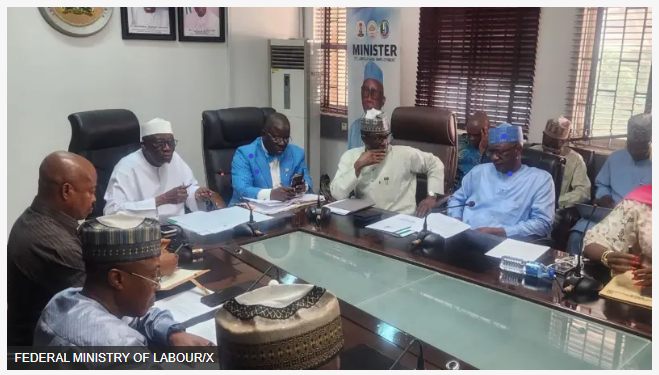
- 12 October: In a letter, Labour Minister Dingyadi said the wage is due for review on 1 June 2027. He called an earlier review premature and noted ₦70,000 was a 133% rise on ₦30,000, per The Will.
- After the reply: The NLC rejected the three-year timeline. Vanguard reported that a strike looms.
- Early November: The TUC rejected a fresh wage award and asked for ₦300,000 for federal workers, as reported here.
Why the FG and NLC disagree on timing
Both sides point to the same three-year cycle but count from different dates. The FG counts from the 2024 law, which lands on June 2027. The NLC counts from the 2019 Act, which puts the start of talks around 17 October 2026.
The NLC also says the FG is mixing up two things: starting negotiations and putting a new wage into effect. Talks can begin now, even if a new rate takes months to agree. Read the earlier FG and labor agreement on ₦70k for how the current rate came about.
What unions are demanding, and what is only a proposal?
| Figure | Who wants it? | Status |
|---|---|---|
| ₦500,000 | Unions, with ₦500 per liter of petrol, per leg. ng | Demand |
| ₦300,000 | TUC, for federal workers | Demand |
| ₦100,000 and ₦150,000 | Various proposals | Proposal |
| ₦70,000 | Law since July 2024 | In force |
A wage award is a separate payment or relief measure, not a new minimum wage. The TUC also says the minimum wage is a floor, not a ceiling, so pay above it can be negotiated.
What each state pays (with dates)
State rates change, so check the date on each figure.
States above ₦70,000. A Nairametrics review as of April 2026 put Imo highest at ₦104,000, followed by Ebonyi at ₦90,000. Ogun, Edo, Kebbi, Benue, and Osun also approved higher rates. In 2024, Lagos was reported at ₦85,000, Niger and Akwa Ibom at ₦80,000, and Ogun at ₦77,000. Second-hand reporting says 20 states paid above ₦70,000, while 15 paid exactly that.
States with gaps. In May 2026, the local government workers’ union NULGE said about 20 states had not fully implemented ₦70,000 for local government workers and primary school teachers. It named Kaduna, Gombe, Borno, Yobe, Zamfara, Imo, Ebonyi, Cross River, and the FCT, among others, per Tribune. Note that Imo and Ebonyi appear on both lists, so a high approved rate does not always mean full payment.
Want to know the moment talks start or a new rate is announced? See subscribe options to get Viztadaily’s Nigeria news updates.
What workers should expect
Timeline. The FG’s stated date is 1 June 2027 for the review. Even if talks start earlier, a signed new law takes time. Do not budget around ₦500,000 or any other unconfirmed figure.
Strike risk. The NLC has rejected the FG’s reply, so a strike remains possible. We have no confirmed date. Watch for an NLC National Executive Council announcement.
Private-sector workers. The law covers employers under the Act, and some are exempt. Check the exemptions in the Act itself before assuming you are covered.
What to do if you are underpaid
- Check your payslip against ₦70,000, or your state’s approved rate.
- Ask HR or your accounts office in writing for the basis of your pay.
- Raise it with your union branch. For civil servants and local government staff, that means the NLC, TUC, or NULGE.
- If it is not resolved, report to the Federal Ministry of Labour and Employment or your state labor office.
Keep copies of your appointment letter and payslips. For more on the pay fight, see our report on labor rejecting an accord and our wider Nigeria coverage.
Related reading: Why a ₦70,000 pay promise was announced in 2024.
Frequently asked questions
What is the minimum wage in Nigeria now?
It is ₦70,000 a month, signed into law on 29 July 2024. No new national rate has been approved. Some states pay more.
Has the FG approved ₦500,000 as the new minimum wage?
No. ₦500,000 is a union demand, not an approved figure. The same goes for ₦300,000, ₦150,000, and ₦100,000.
When will talks on a new minimum wage start?
The FG says the review is due on 1 June 2027. The NLC says talks should have started in October 2026. I found no confirmed start date, so watch for official announcements.
Will the NLC go on strike over the minimum wage?
The NLC rejected the FG’s reply to its ultimatum, and reports say a strike looms. We found no confirmed strike date. We will update this page if that changes.
How much is ₦70,000 in dollars?
Employsome puts it at about US$53. The exact figure moves with the exchange rate.
“Just to be clear, we say that the national minimum wage is decided by a process involving the labor movement, the government, and representatives from employers.” The NLC’s job at this point is clear and unmistakable: to negotiate the national minimum wage, which is the main and most basic wage that no worker should be paid less than.
According to the labor center, setting the minimum wage is not the same as negotiating for subsequent changes, which involve looking at current pay structures to make room for the newly agreed upon wage floor.
It said that the NLC wasn’t directly involved in negotiating these changes at the national minimum wage table, but that they should be talked over separately by the unions that represent workers in different industries.
It said, “The NLC does not sit at the table to negotiate changes that will have a big impact on the different sectors.”
It was also made clear by Congress that it is up to the leaders of unions in both the public and private sectors to negotiate the necessary pay changes in their own areas of work.
It was decided that the Joint Public Service Negotiating Council would be the best group to talk to the Federal Government about the new minimum wage and the changes that will happen for public sector workers following it.
The NLC has been able to separate the process of negotiating the national minimum wage from the later process of checking pay structures to make sure they are in line with the agreed-upon minimum wage.
While Congress is discussing the minimum wage for workers, each sectoral group should talk to its own companies about how the new wage will affect current pay scales and other plans for workers’ pay.
But the labor organization said it was still committed to making sure that the upcoming talks led to a solution that reflected the real economic situation that Nigerian workers and the general population are facing.
It said that its goal was still to reach a wage level that would help workers in a useful way and get closer to the standard of a living wage.
The statement also said, “The NLC will do its best to make sure that the outcome of this upcoming exercise continues to serve the Nigerian workers and masses and comes close to a living wage.”